
Lookup Classic Car VINs with 5-14 Digits
Decode any classic car VIN with our specialized classic car VIN lookup tool. Get a free VIN decode to view key vehicle details year, make, model, engine, and transmission. Need more than specs? Unlock a full history report with title, accident, ownership, auction, odometer, theft, and salvage records.


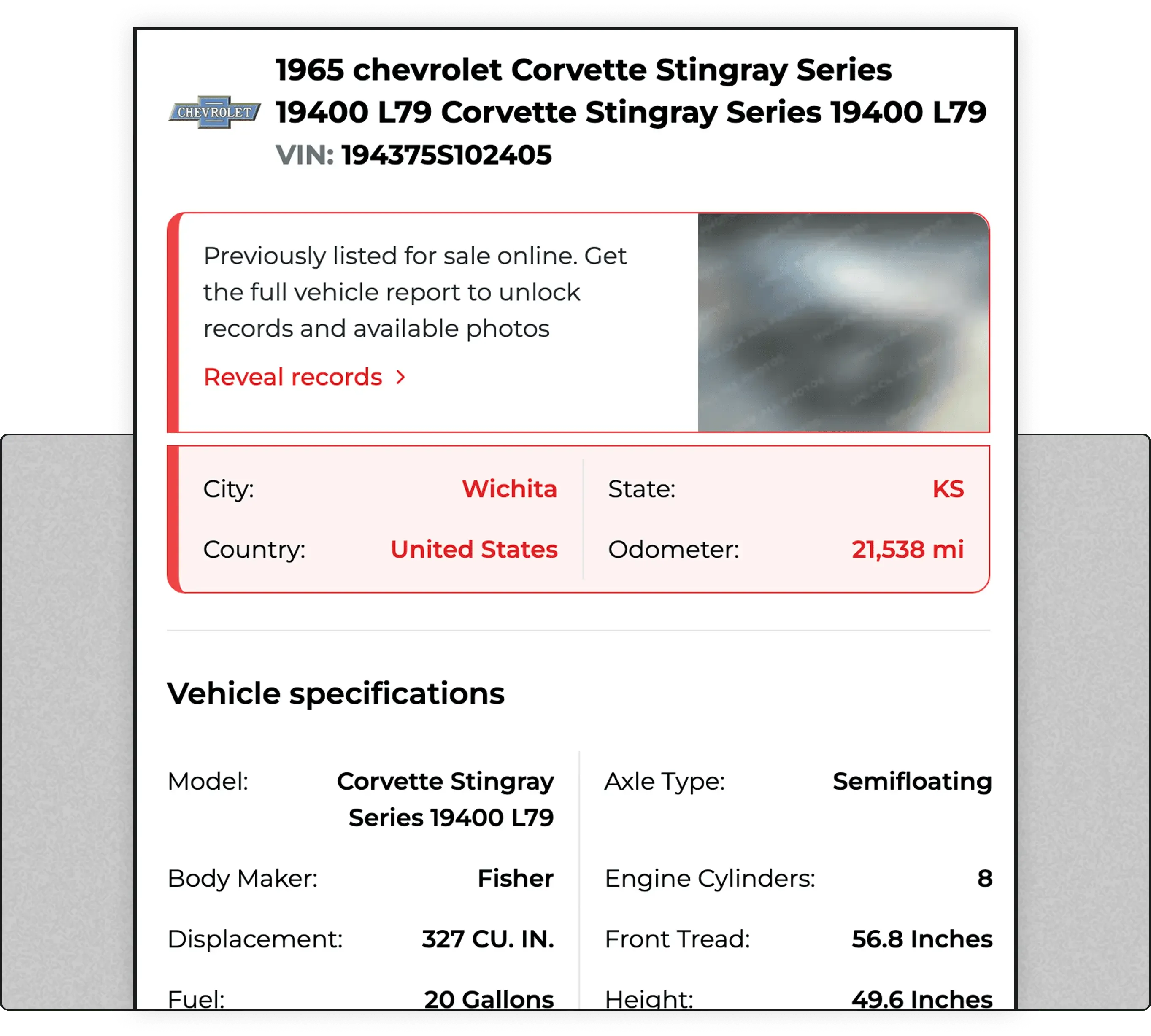
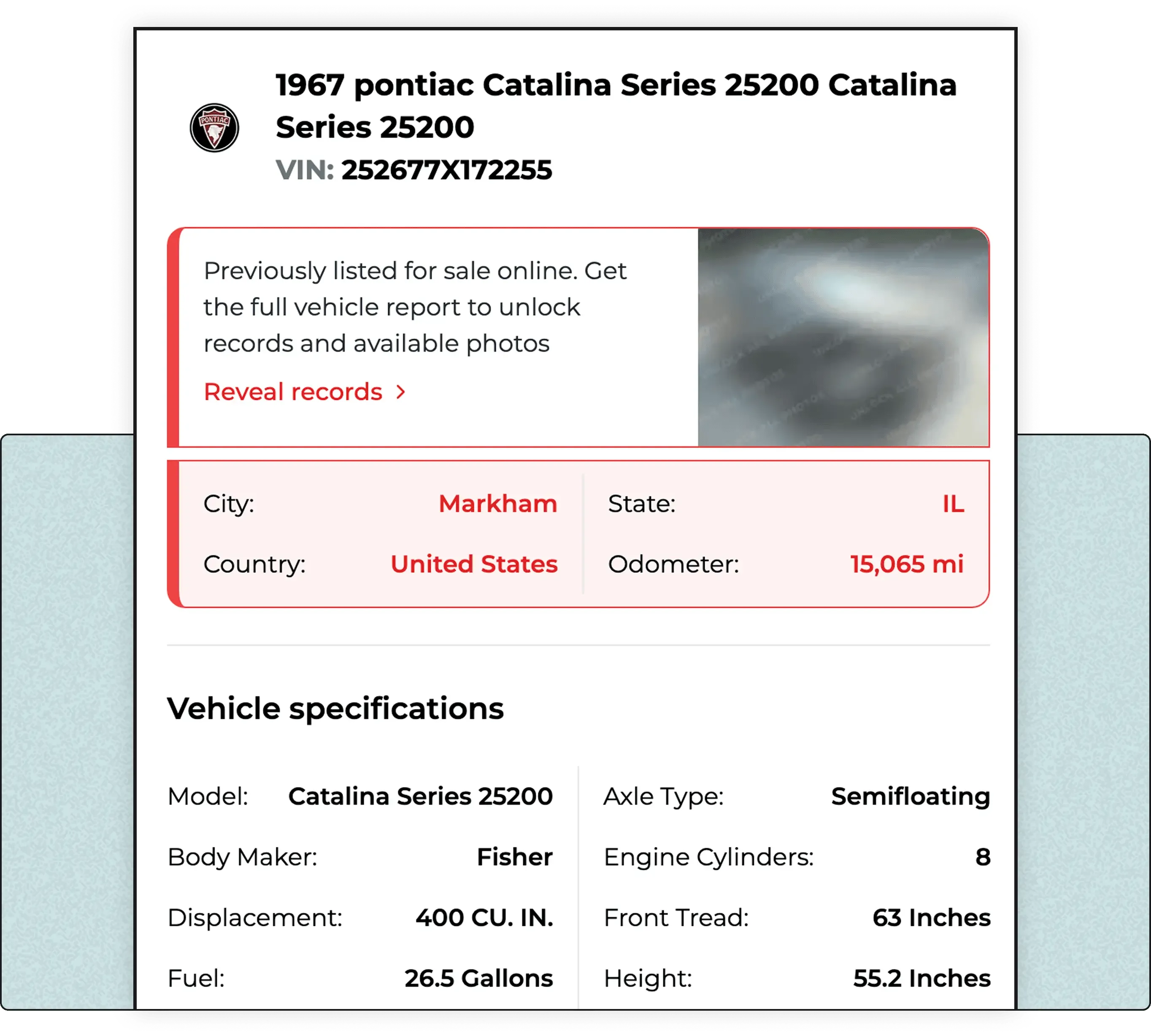
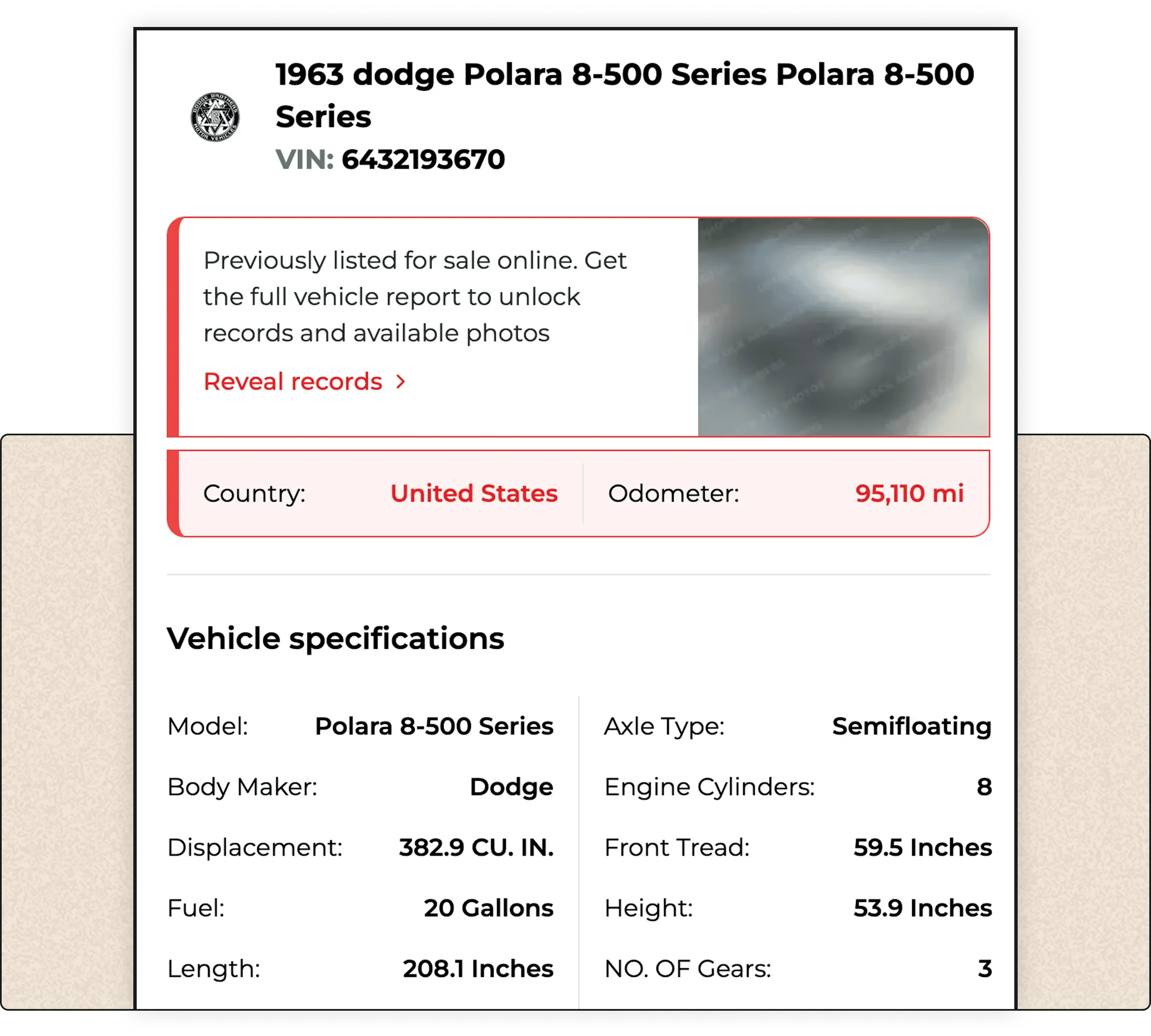
What You Get from Our Classic Car VIN Report?
Our tool helps you do important things before you buy, sell, or restore a vehicle: confirm the vehicle’s specifications with a free VIN decode, and you can unlock deeper history records when you need a full report.
Free Classic VIN Decode
The information provided includes:
 Transmission
 Drive type
 No. of doors
 Engine information (Type, cylinder, displacement, torque)
 No. Of Gears
 Axle type
 Wheels, rims & tires
Full Classic Vehicle History Report
If you need deeper records, upgrade to access a full classic car history report with:

The Risks of Buying Without a Classic Car VIN Check?
Skipping a classic car VIN check when buying a classic car might save twenty bucks now, but you could lose thousands later when you find out what you actually bought. Here are the risks of buying without running a check:

You Might Buy a Stolen Car
The car can look legit until police recover it as stolen, and you lose both the car and money. A classic car VIN check helps confirm it’s clean and legally yours to own.

The Car Could Have a Salvage Title
A rebuilt classic may hide crash or flood damage, lowering value and making insurance harder. A classic vehicle history report can reveal salvage history before you spend a single dollar.

The Mileage Might Be a Lie
Odometers can be rolled back, so “low miles” may be fake and the car more worn than expected. A classic car VIN decoder helps verify mileage records so you know exactly what you're getting.

It's Not the Car You Think It Is
You could pay collector prices for a clone or parts-swapped model. Checking the old car VIN number against factory details helps confirm authenticity and protects the true value of your investment.

There Could Be Money Owed On It
If there’s a lien, a lender may claim the car or demand payment from you. A classic car VIN check can help reveal lien or loan records before the car becomes your financial problem.

You Won’t Know About Past Accidents
A great-looking car may still have a hidden frame or flood damage that causes long-term problems. A classic vehicle history report can show past damage and save you from costly surprise repairs down the road.
The Benefits of Getting a Classic VIN Lookup
If you're buying, selling, or just love working on classic cars, our classic car VIN number lookup tool can help find accurate vehicle information and records. Here’re some of the benefits to classic car buyers, sellers and restorers:
Buyers
Stop guessing and start knowing exactly what you're paying for before handing over your money.
Avoid Scams
See if the car is stolen, cloned, or hiding a salvage title before you buy.
Check Real Mileage
Find out if the odometer was rolled back so you know the extent of wear.
Buy With Confidence
Get the full classic car history so you never feel tricked after driving the car home.
Sellers
If you’re selling, you can easily show buyers your car is the real deal and make selling faster and easier.
Build Instant Trust
Provide a clean classic car history report and buyers will feel good about your asking price.
Sell Faster
Buyers are more likely to say yes quickly when the car's history is fully transparent.
Justify Your Price
Prove your classic's true value with verified records that back up every dollar you ask.
Restorers
Know exactly what you're working with before spending time and money on any restoration project.
Confirm Originality
Check factory details to make sure the parts and numbers match what the car should be.
Reveal Past Damage
Find hidden accident or flood history so no costly surprises show up during your restoration.
Protect Your Investment
A verified vehicle history makes your finished restoration worth more to future collectors and potential buyers.
Where is the VIN on a Classic Car?
For a classic car manufactured before 1981, the VIN can typically be found in the following places:
On the Car
Just like a modern car, there are several locations of the VIN on pre-1981 vehicles. Check the following places for the VIN:
 On the dashboard, near the driver’s side windshield. It’s very visible from the outside.
- Check inside the wheel well by the driver’s side.
- On the firewall
- On the driver’s door hinge post
- Under the steering column
- On components like the engine and firewall
- On the driver’s or passenger side’s frame rail
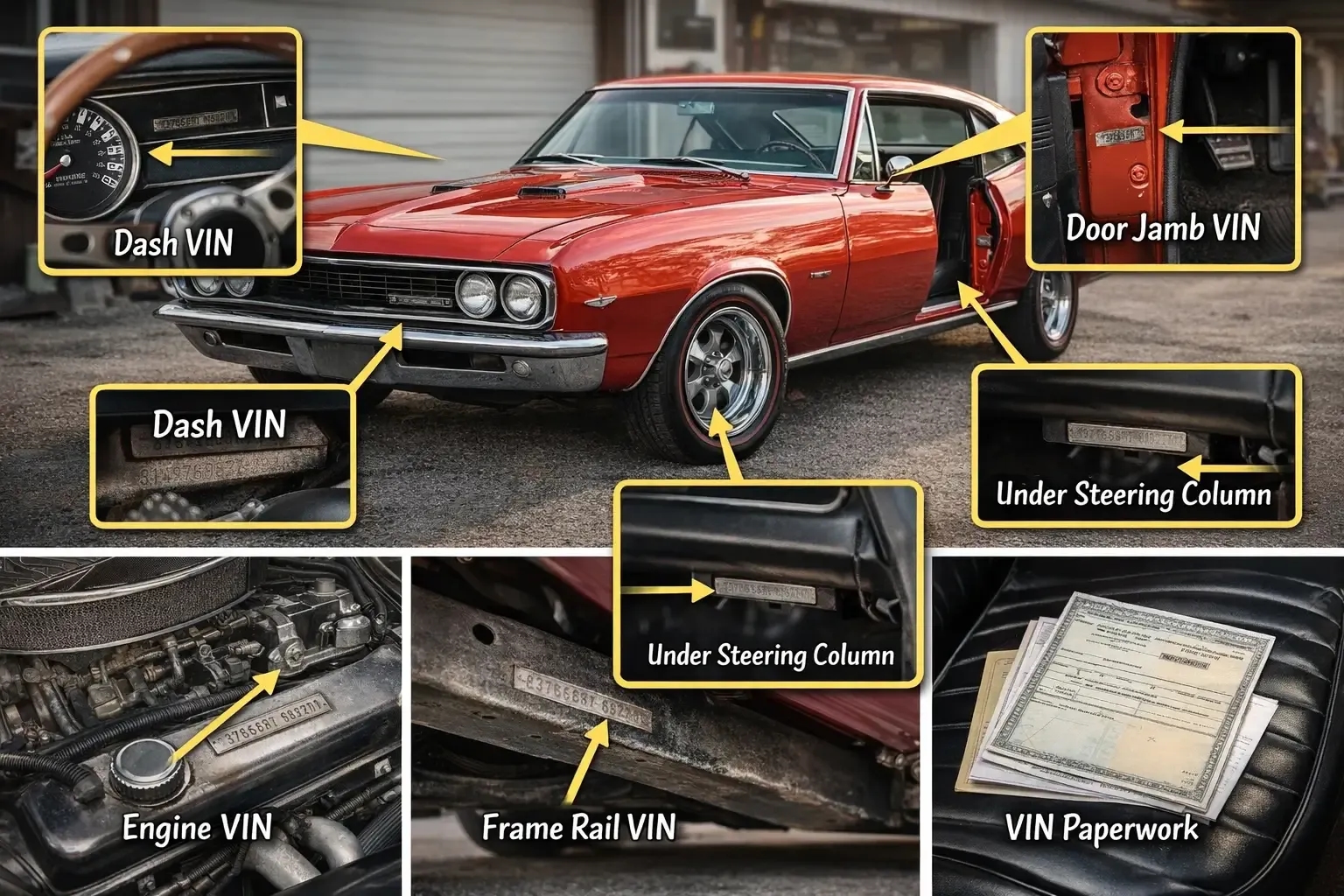
In the Vehicle Paperwork
You can also find the classic car VIN number by checking these documents:
- The car title
- The car registration
- Insurance policies
- Bill of sale
- Maintenance records
How to Look Up Classic Car VIN Numbers
Conducting an antique car VIN lookup is made possible and fast using our tool. Follow these three easy steps to get any pre-1981 vehicle history reports.
- 1
Enter the VIN
Enter the classic VIN into our tool. We support many 5–14 digit VIN numbers commonly found on pre-1981 vehicles. - 2
Preview Vehicle Details for Free
Click “Decode Classic VIN” to view available vehicle specifications such as the year, make, model, engine, transmission, fuel type, drive type, wheels, axle type, and body details. - 3
Unlock the Full Report
If you need more than decoded specifications, purchase the full classic vehicle history report to access title, accident, ownership, auction, odometer and other records. Your report is available instantly and can be downloaded as a PDF.



Want to learn about classic vehicles specifications, original base price and more?
How Our VIN Lookup Tool Saved Buyers Thousands
Real Customer Story
In September 2025, a collector nearly paid a premium for a 1967 Pontiac Catalina listed by a private Ohio seller. Freshly detailed and convincingly restored, it appeared flawless. Our vehicle history report, however, told a completely different story.
The Red Flags Hidden in Plain Sight
The report revealed the following records:
- ▶Accident records (1)
- ▶Damage records (2)
- ▶Auction appearances (2)
- ▶A salvage title brand
- ▶Six owners (1996-2019)
- ▶Possible odometer fraud(Mileage dropping from 108,000 to 11,688 miles)
Outcome
The buyer confidently made a decision to walk away, saving thousands of dollars.
Popular Classic Car Makes, Model Years, and VIN Formats
Lists popular classic car makes, models, VIN lengths, and sample VIN formats by year range, covering vehicles built before 1981.
| Year Range | Makes | Popular Models | VIN Length | Example VIN |
|---|---|---|---|---|
1930s–1940s | Ford, Chevrolet, Dodge, Cadillac, Packard | 1936 Ford 5 Window Coupe, 1938 Dodge D8, 1940 Cadillac Convertible, 1940 Chevy Street Rod | Usually serial-based; often 5–10 characters | A12345, D8123456 |
1950s | Chevrolet, Buick, Ford, Mercedes-Benz, Packard | 1950 Chevy Truck, 1953 Buick Special Riviera, 1957 Chevy Bel Air, 1959 Mercedes-Benz 190SL | Commonly 6–12 characters | VC57A123456, A8A123456 |
1960s | Ford, Chevrolet, Buick, Cadillac, Dodge, Mercury, AMC, Volkswagen | 1965 Mustang, 1966 Chevelle SS 396, 1967 Mustang, 1969 VW Bus, 1969 Rambler Scrambler | Often 8–13 characters, depending on make | 5F08A100001, 138176A123456 |
1970s–1980 | Buick, Cadillac, Dodge, Ford, GMC, Mercury, Fiat, Toyota, Volkswagen, Plymouth | 1970 GMC Jimmy, 1971 Buick Riviera, 1972 Oldsmobile 442, 1977 Toyota Celica GT, 1979 Cadillac Eldorado Biarritz | Commonly 10–13 characters before 1981 | XS29L0G123456, 3J57K2M123456 |
Why Choose Our Classic Car Lookup by VIN Service?
Find everything you need to know about a classic car, all in one place. From original factory build sheets to full vehicle history reports, here is why buyers, sellers, and collectors trust us:
Worldwide Classic VIN Coverage
Search classic VIN numbers from around the world. We also support all types of classic VIN formats from 5 to 14 digit VIN numbers:
Unlimited Free VIN Decoding
Decode basic classic vehicle specs as often as you need. There are no limits on free VIN lookups for specification checks.
Detailed Auction Insights
Access past listings, sale history, and available condition photos for a clearer view of the vehicle’s market activity and background.
Trusted and Updated Data Sources
We get classic vehicle data from the most trusted sources in the industry, so every report you get is accurate, reliable, and complete.
Report Format in Digital PDF
Your report comes as a clear digital PDF. Download, save, print, or share it anytime you need.
24/7 Customer Support & Live Chat
Need help anytime? Our friendly support team and live chat are available 24/7 to answer your questions
Classic Decoder vs. Carfax vs. AutoCheck: Which is the Best Choice?
We help you learn the truth about any classic car's history and specs. Unlike Carfax, we specialize in decoding short VINs with 5-14 digits. Here's why we're the best choice when compared to other VIN decoding services:
| Feature | Classic Decoder | Carfax | AutoCheck |
|---|---|---|---|
Pre-1981 VIN support | Yes, back to 1903 | No | No |
Short VIN decoding (5-14 digits) | Yes | No | No |
Classic car specs | Yes | No | No |
Classic car build sheet | Yes | No | No |
Classic vehicle history report | Yes | No | No |
Classic motorcycle VIN support | Yes | No | No |
What Classic Car Enthusiasts Are Saying About Us
SB Samuel Bonacci Aug 24, 2024•US It was very easy for me to obtain the information I needed in regards to my vehicle I am looking to sell. In a world of buyer beware it helps put potential buyer at ease to see the report confirming the information I have given him. This service is fairly priced which was another advantage. | |||
JA Jim A. Jan 10, 2025•US Very outstanding service! I had a few difficulties on my end and the rep jumped on it, fixed my issue and even through in another discount. There is nothing better than that kind of service. I will be getting all of my future reports from them, hands down the best. | |||
E Erik Jan 19, 2025•US This site had great options for a variety of products that we could want to support our needs of reports. Was delivered via email and downloadable from the website for optimal convenience in the most helpful formats. | |||
RF RICH FLORES Jan 14, 2025•US Sam Adams provided me with the best experience. He was patient and walked me through getting the report and window sticker for my vehicle. I really appreciate his service… It has been refreshing. | |||
SB Samuel Bonacci Aug 24, 2024•US It was very easy for me to obtain the information I needed in regards to my vehicle I am looking to sell. In a world of buyer beware it helps put potential buyer at ease to see the report confirming the information I have given him. This service is fairly priced which was another advantage. | JA Jim A. Jan 10, 2025•US Very outstanding service! I had a few difficulties on my end and the rep jumped on it, fixed my issue and even through in another discount. There is nothing better than that kind of service. I will be getting all of my future reports from them, hands down the best. | E Erik Jan 19, 2025•US This site had great options for a variety of products that we could want to support our needs of reports. Was delivered via email and downloadable from the website for optimal convenience in the most helpful formats. | RF RICH FLORES Jan 14, 2025•US Sam Adams provided me with the best experience. He was patient and walked me through getting the report and window sticker for my vehicle. I really appreciate his service… It has been refreshing. |
Find the Right Tool with Our Top VIN Lookup Services
Your classic car checks are in good hands. Use our tools to find the right car and get good, fair deals and pricing. Buy smart and sell with total confidence with our best-in-class tools
Build Sheets for Vintage Cars
Classic car build sheet showing factory specs, original price, features, colors, production numbers, and details for accurate restoration and value insight.
Classic Car Values
Classic car valuation tool with market-based pricing, condition ranges, VIN lookup, and value insights to help with buying, selling, insurance, and collecting.
Decode VINs for All Classic Car Makes
From American muscle to European classics and everything in between, our classic car VIN decoder covers nearly every classic car brand. Whatever you own, we can decode it.
Classic VIN Decoder App |
Now available on both Android and iOS!
At Classic Decoder, we believe that developing a mobile app is a great way to extend our classic car data solution hub to as many users as possible across the globe. Our app is built with users and precision in mind. It holds the key to unlocking the history and details of any retro car at your fingertips. It also comes with fascinating and user-friendly features that make it stand out from other mobile apps designed for this purpose.
The Classic Decoder app lets you decode and lookup any classic VIN in a flash. Access accurate vehicle information and history, make an informed decision faster, and buy and trade in classic cars with confidence.
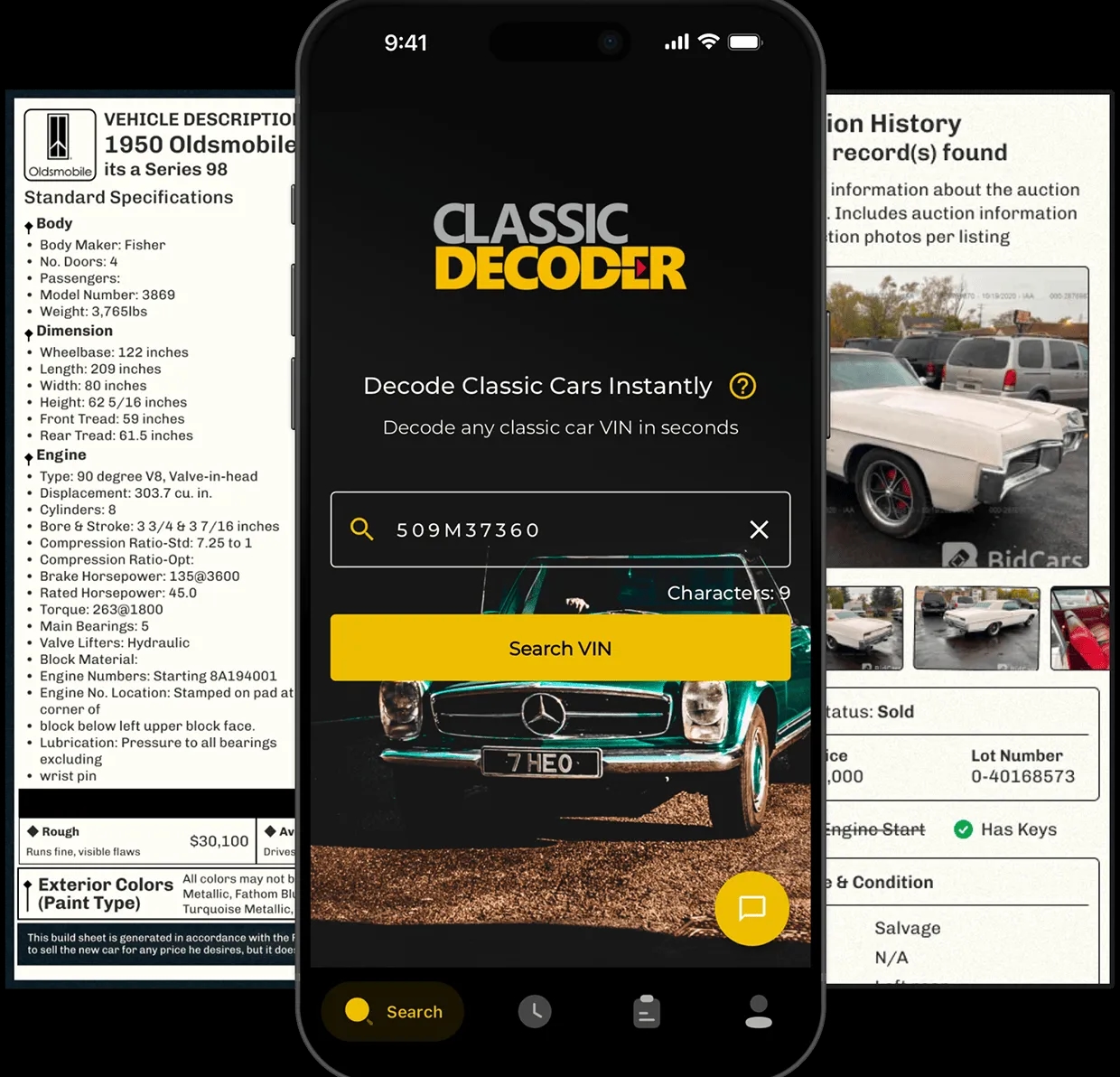
Download The Classic Decoder App now.


Some unique features include:
- Support all classic VIN lengths from 5 to 14 digits
- Support classic cars produced from 1910 – 1980
- Online Garage features – to add and manage your vehicles
- 24/7 Customer Support
- Easy onboarding for first-time users
FAQ About Classic Car VIN Lookup
A classic car is basically an older vehicle that collectors care about, usually at least 20 years old. Some people say it's anything from 20 to 40 years old - it really varies. What makes them special is their history, how they look, and whether they're still original. Keeping them that way takes work.
There's no one answer - it depends on where you live and who you ask. Most states call a car "classic" when it hits 20 to 25 years old, at least for registration and insurance. But other groups have their own rules. The Classic Car Club of America only counts cars made between 1915 and 1948.
Do the following to find a VIN for an old car:
- Find the serial/VIN plate on the driver’s side dashboard, door jamb, or engine block.
- If not found, check old titles, registration, insurance documents, or dealer records.
- For a classic car you cannot identify, apply for a state-assigned VIN through the DMV, which may require an inspection.
To check a classic car VIN number, first locate it on the dash (driver's side), doorjamb, or frame, then enter the VIN into our classic car VIN lookup tool to decode the VIN nd access vital information like model, engine, transmission , options, and more. Ensure the VIN on the car matches with original documents like titles, registrations, and receipts for authenticity.
Yes, there are free VIN number check tools for old and vintage cars. Classic Decoder offers a free pre-1980 VIN number search tool that provides the complete specifications of the car, like the year, make, model, engine, transmission, and more.
Carfax doesn’t work for pre-1981 classic cars but works well with models from 1981 with 17 digit VIN numbers. To accurately decode pre-1981 classic car VINs with 5-14 digits, use our classic car VIN check tool.
The VIN numbers for vehicles manufactured before 1981 can have varying length, usually from 5-14 digits. The VIN length was standardized to 17-digits for 1981 and later vehicles.
After checking common locations on the car and still unable to find the VIN, you should get in touch with your state’s Department of Motor Vehicle (DMV) to help verify the identity. This will keep you safe from operating illegal vehicles. You might also get a new VIN plate issued or assigned a number for registration.
Most VIN lookup tools are built for modern 17-digit VINs, which became standardized in 1981. But many classic and antique vehicles were produced before that change, which means they often use shorter VIN formats.
That is why a standard VIN check service may not work well for an older vehicle.
Our tool is built specifically for 5–14 digit VINs, making it a better fit for:
- classic car vin lookup
- old car vin lookup
- antique car vin lookup
- classic car checks
- pre 1980 vin number search free
If you need to research a pre-1981 vehicle, verify a seller’s claims, or confirm vehicle identity before purchase, using a specialized classic VIN lookup tool is the smarter option.