
Decode Classic VINs to Get Vehicle History Report and Build Sheet
Popular Articles
Document Your Restomod Donor Before Pulling the Original Engine
Buying a Restomod With Thin Paperwork: What the VIN Still Tells You
What to Check Before Buying a Restomod Car
How Vehicle History Reports Impact Classic Car Transactions
Paid Classic Car History Check Vs Free Report Compared
How to Check a Classic Car Auction History Before You Buy
How to Detect Mileage Rollback in Classic Cars
How to Spot Hidden Damage Before Buying a Classic Car
How a Build Sheet Helps in Classic Car Restoration
Build Sheet vs Car History Report: What’s the Difference?
Recommended Classic VIN Lookup Tools
Top Seven Ways to Modernize a Classic Car
Aug 19, 2024
Key Takeaways
 Modern upgrades can improve a classic car’s braking, cooling, comfort, reliability, handling, and everyday drivability.
- Common upgrades include electronic ignition, electric cooling fans, disc brakes, air conditioning, radial tires, engine swaps, and power steering.
- Plan each upgrade around your car, driving needs, budget, original specifications, and local safety or emissions requirements.
Modernizing a classic car can improve its safety, comfort, reliability, and performance while keeping the style that makes the vehicle special. These upgrades are often part of what a restomod project is.
Before you start, think about how you plan to use the car. A weekend cruiser may need different upgrades than a classic car used for long trips or regular driving.
SEMA has reported growing interest in modifying classic vehicles with modern engines, improved performance, and contemporary comforts. Its research estimated more than 9.4 million pre-1990 vehicles on U.S. roads.
Modernizing Classic Cars: 7 Upgrades to Consider
Classic car upgrades can range from simple safety improvements to major mechanical changes. The right combination depends on the vehicle and how you want to drive it.
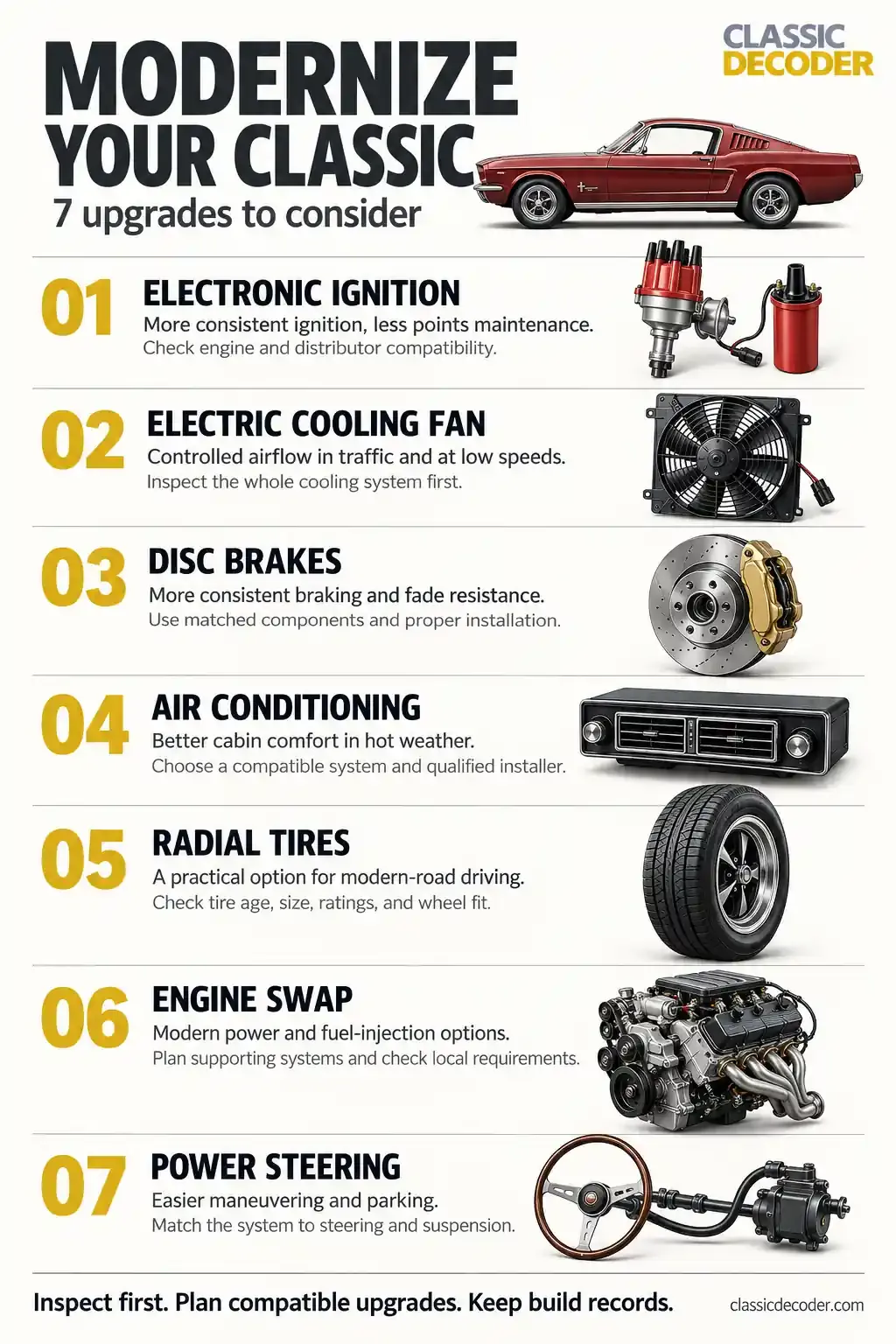
Here are seven common upgrades to consider when modernizing a classic car.
1. Upgrade to Electronic Ignition
Many older cars use mechanical contact points as part of their ignition systems. These parts can wear over time and may require regular inspection and adjustment.
An electronic ignition system replaces the traditional points with electronic components. This can reduce maintenance and provide more consistent ignition operation.
Electronic ignition does not necessarily mean replacing the entire ignition system. Some kits are designed to work with the original distributor, making them a practical upgrade for certain classic cars. Before choosing a system, check that it is compatible with your engine and distributor.
2. Install a Modern Electric Cooling Fan
Older vehicles often use belt-driven mechanical fans. Their speed is linked to engine speed, so cooling performance can vary with driving conditions.
An electric cooling fan can provide more controlled airflow. A temperature switch or electronic controller can turn the fan on when the engine reaches a set temperature. This can be especially useful when a classic car is sitting in traffic or moving slowly, when airflow through the radiator may be limited.
Is this a Cure for Overheating?
Not really. An electric fan is not a guaranteed cure for overheating. The radiator, water pump, thermostat, hoses, airflow, and cooling system must also be in good condition. A properly designed cooling system should be checked before adding a larger fan.
3. Upgrade the Brakes to Disc Brakes
Braking is one of the most important areas to consider when modernizing a classic car.
Many older vehicles were equipped with drum brakes. While drum brakes can work well when properly maintained, a disc brake conversion can provide useful benefits for some classic car applications.
How it Benefits
Disc brakes can offer more consistent braking performance and better resistance to brake fade under certain driving conditions.
A complete upgrade may include rotors, calipers, brake lines, a master cylinder, and other supporting components.
The correct parts depend on the car. Brake upgrades should be installed and tested carefully because braking changes directly affect vehicle safety.
4. Add or Upgrade the Air Conditioning
Air conditioning can make a major difference if you plan to drive your classic car during hot weather. Some older cars were never equipped with factory air conditioning. Others have systems that use older components or refrigerants that are no longer practical to service.
Modern replacement systems can be designed to fit classic vehicles while providing heating, cooling, and better climate control.
What to Know Before an Air Conditioning Upgrade
If your car originally used CFC-12, commonly known as R-12, an approved retrofit may allow the system to use another refrigerant. EPA identifies HFC-134a as a primary refrigerant used for CFC-12 retrofits, although compatibility varies by vehicle and system.
Air conditioning work should be handled by a qualified technician. In the United States, technicians who service motor vehicle air-conditioning systems for payment must meet EPA Section 609 certification requirements.
5. Replace Old Tires With Suitable Radial Tires
Tires are another important upgrade for many classic cars. Older vehicles may still have bias-ply tires, while modern radial tires are widely available for classic applications. Radial tires can provide different handling, ride, and traction characteristics compared with traditional bias-ply designs.
However, choosing tires is not only about switching from bias-ply to radial construction. You also need the correct size, load rating, speed rating, wheel compatibility, and inflation pressure.
Tire Age Is Also Important
NHTSA warns that tires become more prone to failure as they age, even when tread remains. Collector cars that are driven infrequently can be especially vulnerable to tire aging.
Check the tire identification information and replace old or damaged tires before putting serious miles on your classic.
6. Consider an Engine Replacement or Swap
An engine swap can completely change how a classic car performs. A newer engine may provide more power, improved reliability, electronic fuel injection, and easier access to replacement parts.
However, an engine swap is a major project. The engine must work with the transmission, cooling system, fuel system, electrical system, exhaust, suspension, and brakes.
Consider Emissions & Legal Requirements
You also need to consider emissions and legal requirements. The EPA notes that changes to a vehicle’s original engine design can create Clean Air Act compliance issues in certain circumstances.
Before choosing an engine, research the requirements for your vehicle and location. A professional builder can also help you select a drivetrain that works as a complete system.
7. Add or Upgrade Power Steering
Power steering can make a classic car easier to maneuver, especially at low speeds and during parking.
This can be useful for older vehicles that were designed without power steering. Depending on the car, an upgrade may involve adding an electric or hydraulic power steering system.
Modern electric power steering systems can assist without requiring a traditional hydraulic pump and fluid system.
The correct setup depends on the vehicle. Steering geometry, suspension components, wheel size, and available space should all be considered before installation.
READ ALSO: What to Check Before Buying a Restomod
How to Choose the Right Modern Upgrades for Your Classic Car
The best upgrades are not always the most expensive ones. Start by identifying the problems you want to solve and how you plan to use the vehicle.
Start With Safety
Safety should be considered before cosmetic upgrades. Inspect the brakes, tires, steering, suspension, lighting, seat belts, and other critical systems. Upgrading these areas can make your classic car more suitable for modern traffic without changing its appearance too much.
Think About Your Driving Habits
Consider where and how often you drive. Highway use may require different upgrades from short weekend trips. If you regularly drive in hot weather, cooling and air conditioning may be priorities. If you drive in heavy traffic, braking and steering improvements may matter more.
Protect the Classic Character
Modernizing a classic car does not mean replacing everything. Many owners keep the original body, dashboard, seats, wheels, or other details while upgrading the mechanical systems underneath. This approach can preserve the vehicle's visual identity while making it more enjoyable to drive.
Check the Original Specifications
Before removing original components, learn what the car had when it left the factory. You can check the VIN before buying a restomod so as to view the original engine, equipment, options, colors, and other factory details available for the vehicle.
This information can help you decide which parts to keep and which components can be safely changed.
Other Modern Upgrades for Classic Cars
The seven upgrades above are not your only options. Depending on your goals, you can also modernize other areas of the vehicle.
Some common choices include:
- Modern seats and upholstery
- Improved headlights and lighting
- Bluetooth audio systems
- Modern speakers
- Digital gauges
- Power windows
- Improved seat belts
- Modern fuel injection
- Upgraded exhaust systems
- Better wheels
- Modern navigation systems
- Improved sound insulation
Some owners also choose turbochargers, superchargers, or electric drivetrains. These are much larger projects and require careful planning.
Who Should Modernize a Classic Car?
Modernization can be handled in several ways. Your choice should depend on the complexity of the project, your skills, budget, and safety requirements.
Professional Mechanic
A qualified mechanic can handle mechanical upgrades such as brakes, suspension, cooling systems, steering, and engines. For major safety-related work, professional installation can help ensure that the components work together correctly.
Restomod Company
Restomod companies specialize in building or modifying classic vehicles. They can often handle large projects involving engines, transmissions, suspension, interiors, electrical systems, and bodywork.
The cost can be higher, but you may get a complete build instead of managing several separate contractors.
Custom Car Builder
A custom builder can help with appearance, interiors, accessories, and other personalized changes. Some builders specialize in specific makes or models, so finding someone familiar with your particular classic car can be helpful.
What to Check Before Modernizing a Classic Car
Before removing parts or ordering upgrades, take time to inspect the vehicle and create a project plan.
Check the Vehicle's Condition
Do not assume an old car only needs new parts. Look for rust, frame damage, worn suspension components, leaking fluids, electrical problems, and other issues. Fixing basic problems first can prevent new upgrades from hiding larger mechanical concerns.
Set a Realistic Budget
Restomod projects can grow quickly when you begin replacing multiple systems. Create a budget that includes parts, labor, fabrication, paint, wiring, fluids, and unexpected repairs. It is also wise to keep some money aside for problems discovered after the project begins.
Keep Records of the Changes
Save receipts, photographs, part numbers, installation records, and information about the original components. Good records can help with future repairs and give potential buyers a clearer understanding of what was changed.
READ ALSO: Why You Need to Document Your Restomod Donor Before Engine Removal
Are Modern Upgrades Worth It for a Classic Car?
Modern upgrades can make a classic car safer, more comfortable, reliable, and enjoyable to drive. However, every modification should have a clear purpose.
Begin with the areas that matter most to your driving needs. For many owners, that means tires, brakes, steering, cooling, and electrical reliability before moving to major performance upgrades.
You should also consider the car's originality. Some rare classics may be more desirable in their original condition, so research the vehicle before making permanent changes.
Conclusion on Modernizing Classic Cars
Modernizing classic cars can give you the best of both worlds: the character of an older vehicle and the convenience of modern automotive technology.
Understand your goals, inspect the vehicle, and choose upgrades that work together. Safety systems such as brakes, tires, steering, and cooling deserve careful attention before performance or cosmetic changes.
If you are planning a restomod, understanding the vehicle's original equipment can also help. A classic car build sheet can show important factory details and give you a useful starting point for your project.
Frequently Asked Questions About Modernizing a Classic Car
The best first upgrade depends on the vehicle's condition and how you plan to use it. Safety inspections should come first, followed by tires, brakes, steering, cooling, and electrical reliability.
Yes. Modern technology can be added to many classic cars. Common upgrades include electronic ignition, digital gauges, Bluetooth audio, air conditioning, electric cooling fans, modern lighting, and power accessories.
Yes. Disc brakes can provide consistent braking performance and may resist fade better than drum brakes in some applications. However, the correct conversion depends on the vehicle and should be properly installed.
Radial tires can improve ride and handling characteristics on many classic cars, but compatibility matters. Check tire size, load rating, wheel fitment, inflation requirements, and the vehicle manufacturer's recommendations before switching.
Yes. A modern engine can be installed in many classic cars, but an engine swap affects several systems. Check transmission, cooling, fuel, exhaust, electrical, braking, emissions, and local legal requirements before starting.
It can, but there is no universal outcome. Value depends on the vehicle, originality, quality of modifications, documentation, rarity, and buyer demand. Research the specific model before making major changes.
Yes, original build information can be useful before a restomod. It can help you identify factory equipment, options, colors, and specifications before deciding which components to keep or replace.

Content Writer
Adewale Peter is an automotive researcher and writer specializing in classic and pre-1981 VINs, historical vehicle identification, factory documentation, and classic-vehicle records. He writes about older VIN formats, archival research, Build Sheets, title and registration issues, and the limitations of modern decoding tools when applied to classic vehicles.