
Check Original Engine Specs for any Classic Car
Find the exact engine configuration and ensure correct parts using our classic car engine check tool. Enter the VIN, and pull the original factory specifications like size, cylinders, fuel type, and more, in seconds.


Decode Classic VINs to Get Vehicle History Report and Build Sheet
What Is a Classic Car Engine Check?
A classic car engine check is a lookup that tells you the original engine a vehicle left the factory with, based on its VIN. It covers everything from engine size and type to horsepower and factory-installed options.
Some of the most iconic engines ever built, like the Chevrolet Small-Block V8, the Ford 289 Hi-Po, and the Pontiac 400, are only worth their full value when the numbers match. For buyers, sellers, collectors, and restorers, a simple engine check can be the difference between a smart deal and an expensive mistake.
Why Check a Classic Car Engine Before You Buy or Restore
A classic car without a verified engine history is a risk. Here's why both buyers and restorers should always check a classic car engine by VIN.
Buyers
Buyers need to know they're paying the right price, and that the engine under the hood is actually the one the car was born with. Knowing a car’s exact engine helps buyers in the following ways:
Avoid Paying for a Swapped Engine
An engine swap can cut a classic car's value by 30–60%. A classic car engine lookup can tell you if the listed engine is the original one or a replacement.
Confirm Numbers-Matching Status
Numbers-matching classics, where the engine matches factory records, command premium prices. You need to verify this before writing a check or any money leaves your pocket.
Spot Hidden Mechanical Red Flags
A classic car’s build sheet data can reveal undisclosed modifications and engine options that a seller might not mention during the sale.
Restorers
Restorers need to know the exact factory specifications to restore a car to its original condition, and guessing at engine details can lead to costly mistakes. Here’s how a classic car engine check helps:
Source the Right Replacement Parts
Every classic engine has specific carburetors, manifolds, and ignition parts. Knowing the exact engine detail means you order the right component the first time.
Match Original Factory Specs for Show Cars
Concours judges check for authenticity. Original engine information, especially from the build sheet, helps you restore to exactly what the factory intended.
Increase the Finished Car's Resale Value
A properly documented, factory-correct restoration sells for significantly more than one with unverified or mismatched engine components.
What Engine Information Can You Find by VIN?
Your VIN holds a surprising amount of engine records. Both a free VIN decoder and a full build sheet lookup can reveal engine specs, but the depth of detail is very different between the two.
Engine Information: Free VIN Decoder vs. Build Sheet Lookup
A free decode gives you the basics fast. The build sheet is the complete factory record, which lists every engine option ordered on that specific car the day it was built.
Here’s how the two compare:
| Information | Free VIN Decoding | Classic Build Sheet |
|---|---|---|
Engine displacement (e.g., 350 cu in) | ✓ | ✓ |
Engine type (V8, Inline-6, etc.) | ✓ | ✓ |
Factory horsepower rating | ✓ | ✓ |
Brake horsepower | X | ✓ |
Carburetor type & configuration | X | ✓ |
Compression ratio | X | ✓ |
Bore & stroke | X | ✓ |
Transmission pairing (factory-matched) | X | ✓ |
All factory-ordered options & packages | X | ✓ |
How to Find a Classic Car Engine by VIN Number
Looking up a classic car engine by VIN is very easy using our tool. The full engine specs can be retrieved in a few clicks, and here's how.
- 1
Enter Your VIN
Type the 17-character VIN into the search field. On older classics, you'll find it on the dashboard, door jamb, or firewall plate. - 2
Search VIN
Hit Get Build Sheet to instantly check the VIN. You'll get the base engine type, displacement, and model year data at no charge. - 3
Get the Classic Car Build Sheet
Unlock the full build sheet to access every factory engine option, carburetor specs, and numbers-matching confirmation for that exact car.
The Engine Secret Hidden in a 1967 Pontiac's Past
Real Story Customer
Mike loved a 1967 Pontiac Catalina he found online. The seller said it had the original factory V8 engine. Mike ran a classic car engine check to find out the truth.
What the Build Sheet Showed
 Type: V8
- Displacement: 400 cu. in.
- Brake Horsepower: 265 at 4,600 RPM
- Torque: 397 at 2,400 RPM
- Valve Lifters: Hydraulic
- Block Material: Cast Iron
What the Numbers Meant
The engine matched the factory specs exactly. No swaps. This Catalina was the real thing.
How the Build Sheet Helped Mike
Mike knew exactly what he was buying. He paid fairly and drove away with no doubts.
Popular Classic Models and their Engine Sizes
Popular classic cars are often remembered by their design and performance, but their engine sizes reveal what truly defines their power, character, and lasting value. Here are some of the iconic classic car engine types:
Classic Model / Group | Engine Type | Common Engine Size / Displacement |
Dodge Charger / Challenger | Slant-six or V8 | 225 Slant-6; 318, 340, 383, 426 HEMI, or 440 V8 |
Plymouth Belvedere / Cuda | Slant-six or V8 | 225 Slant-6; 318, 383, 426 HEMI, or 440 V8 |
Ford Mustang / Galaxie | Inline-six or V8 | 200/250 I6; 302, 351, 390, 427, or 428 V8 |
Ford Flathead V8 Models | Flathead V8 | 221, 239, or 255 V8 |
Pontiac GTO / LeMans | Inline-six or Pontiac V8 | 250 I6; 350, 400, or 455 V8 |
Chevrolet Camaro / Chevelle | Inline-six or V8 | 230/250 I6; 302, 350, 396, or 454 V8 |
Mercury Monterey | OHV V8 | 256 V8 |
International KB-Series Trucks | Green Diamond inline-six | 214 or 233 inline-six |
Volkswagen Beetle / Classic VW | Air-cooled flat-four | 1192 cc / 1.2L flat-four |
Lancia Fulvia | Narrow-angle V4 | 1.2L, 1.3L, or 1.6L V4 |
Why Choose Our Classic Car Engine Lookup Tool?
There may be other engine specs lookup tools out there, but here's what sets ours apart for real classic car enthusiasts like you:

Worldwide Classic VIN Coverage
Search classic VIN numbers from around the world. We support a wide range of classic VIN formats, including 5 to 14-digit VINs used in older vehicles before modern standardization.

Trusted and Updated Data Sources
We gather engine-related records from available trusted sources, including DMV records, auction data, insurance databases, historical factory references, and proprietary automotive datasets where available.

24/7 Live VIN Expert Support
Need help identifying an engine or understanding factory specifications? Our support team is available 24/7 through live chat to help you interpret VIN results and engine details.

Report Format in Digital PDF
Your engine report is delivered in a clean digital PDF format, making it easy to download, save, print, or share for restoration, valuation, or documentation purposes.
Classic Car Engine Check Reviews from Real Users
See how buyers, sellers, collectors, and restorers use ClassicDecoder to verify original engine specs, compare factory data, and make more confident classic car decisions.
Highly recondmend, they helped make a reproduction factory spec sales sheet window sticker as it were in 1993, they also offer car history check. Brilliant prices, must check them out. Very helpull, wonderfull team and excellent service
Steve
I am extremely satisfied with ClassicDecoder.com and their specialized services for classic car VIN lookup and build sheet generation.
As someone who recently completed extensive research before purchasing a classic vehicle, I can confidently say this platform delivers exceptional value for serious classic car buyers.
During my research phase, I purchased a 10 VIN decoder package from ClassicDecoder, which proved invaluable when evaluating potential purchases.
The service helped me make informed decisions right up to the moment I was ready to make an offer.
While the VIN lookup process occasionally required some additional guidance to locate the correct vehicle match, the customer support team responded quickly and effectively. I must specifically highlight Richard, their customer support agent, whose assistance was outstanding throughout my experience.
I ultimately purchased a 1978 Bronco and utilized multiple services to gather comprehensive information about the vehicle. I obtained both a VIN report through ClassicDecoder and a Marty report for comparison purposes. Both services provided valuable information, and I appreciate having access to quality options in the classic car documentation space.
The standout feature was ClassicDecoder's build sheet service, which completely exceeded my expectations in both scope and detail. The build sheet was remarkably exhaustive and granular, providing comprehensive information about every aspect of how the vehicle was originally built and equipped. The level of detail and accuracy was impressive, offering extensive insights into the vehicle's original specifications and factory configuration.
What particularly impressed me about ClassicDecoder's build sheet was its comprehensive nature and the granular detail it provided about the vehicle's manufacturing specifications. This level of thoroughness makes it an excellent resource for anyone seeking detailed vehicle documentation, whether for restoration purposes, verification needs, or general ownership records.
Based on this experience, I would recommend ClassicDecoder's build sheet service to any classic car owner seeking detailed vehicle documentation.
Jonathan L
Classic Decoder offers an easy way to decode the VIN of classic cars, providing detailed reports on vehicle history, specifications, and build sheets. It’s a valuable resource for classic car enthusiasts, ensuring they can verify authenticity, uncover vehicle details, and maintain records. With support for over 500 manufacturers, it's a must-visit for those passionate about classic cars.
Mohammad Ali
I received all the records I was looking for immediately after I ordered them with the build sheet. Super detailed and accurate. Great service for the price👍
Cameron Olski
Classic Car Build Sheet Sample: Find More than Engine Specs
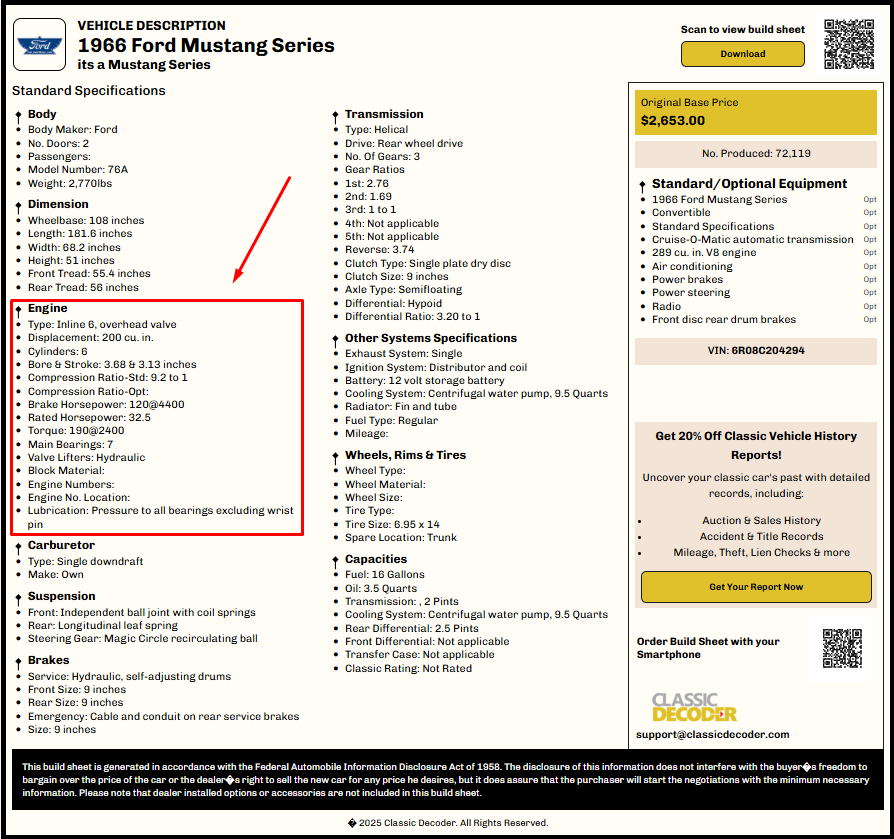
A classic car build sheet is the closest thing to a car's original factory receipt. It lists every option, package, and specification that was ordered and installed on that exact vehicle — including the engine information, transmission, axle ratio, paint, interior, and more.
Unlike the details retrieved with a free VIN decoder, a build sheet is specific to your car's serial number. Two identical-looking 1969 Camaros could have very different build sheets; one might be a base 250 inline-six car, and the other a factory Z/28 with a high-revving 302 V8.
Other Classic Vehicle Check Tools
Here are additional tools to help you find vital information and records on any classic car with 5 to 14-digit VINs.
Get Engine Specs for Popular Classic Makes

Verify Any Classic Car Engine Before Buying
Don't let an unverified engine cost you thousands. Run a full classic car engine check by VIN today, and get factory specs, build sheet data, and numbers-matching confirmation before you commit.
Frequently Asked Questions About Classic Car Engine Check
Your VIN encodes the engine type in the 8th character of the 17-digit number. This may be different for classic VINs with fewer than 17 digits. To know your engine, simply enter the VIN in our tool to instantly see the original engine displacement, type, horsepower, and more.
Yes. The VIN contains an engine code that identifies the cubic inch or litre displacement, cylinder count, and fuel system. Our free VIN lookup tool reveals engine size in seconds, while getting the full build sheet gives you deeper specifications like carburetor and compression ratio.
Yes. The engine option code, such as L48, L82, or Z28 on GM vehicles, is stored in the build sheet tied to the car’s VIN.
Original factory engine options are stored in the manufacturer's build records, linked to each vehicle's VIN. Our classic car build sheet lookup can access those records to show every engine option and specification ordered on your specific car at the factory.
Pre-1981 vehicles predate the standardized 17-digit VIN system. Earlier cars used shorter, manufacturer-specific serial numbers. Data records from that era also weren't digitized uniformly, which is why accessing original factory build sheets requires a specialist tool rather than a modern 17-digit VIN decoder.