
Classic Car Auction History Check by VIN
About 70,000+ classic cars are auctioned each year in the US, and we have the records for each gem. Before you bid on any classic car, check its auction history using our classic auction VIN lookup tool. Know what the car sold for, where, and what condition it was in, so you never overpay or buy blindly.


What Is a Classic Auction VIN Check?
A classic auction VIN check is a search that pulls the auction history tied to a specific vehicle's identification number. It tells you every time that a car appeared at a public or dealer auction, including the sale date, hammer price, lot number, condition report, title status, and available photos.
For buyers, it answers the question every serious collector should ask before bidding: has this car been through auction before, and if so, why? A car that passed through auction multiple times in a short period, or that sold well below its expected value, is telling you something.
Why Should You Check Classic Auction Records by VIN?
Auction history is one of the most honest records a classic car can have; it's third-party, documented, and often includes photos. Here's why you should always check it first.
Buyers
For buyers, an auction history check is one of the clearest windows into what a classic car has been through, and what it's actually worth on the open market.
Know What the Car Actually Sold for Before
If a car sold at auction 18 months ago for $22,000 and the private seller is now asking $45,000, you need to know that. Auction sale records give you real comparable pricing data before you negotiate.
Understand Why the Car Keeps Changing Hands
A classic that has appeared at auction two or three times in five years is raising a flag. Frequent auction appearances often signal a recurring mechanical issue, a title problem, or condition concerns that keep serious buyers walking away.
See the Condition the Car Was in at Auction
Auction records often include condition notes, primary and secondary damage disclosures, and photos taken at the time of sale. That's a far more honest snapshot of the car's real condition than a seller's listing photos taken on a sunny afternoon.
Sellers
For sellers, having a clean and documented auction history, or being able to show the car has never been through auction, is a powerful trust signal that supports your asking price.
Use Past Auction Results to Justify Your Price
If your classic sold at a reputable auction for a strong price, that's documented market evidence. Sharing that result with a private buyer gives your asking price credibility that no amount of seller description can match.
Get Ahead of Questions Buyers Will Ask Anyway
Serious classic car buyers will run their own VIN checks. If the auction history shows something unexpected, it's far better for you to know first, and have a clear, honest explanation ready, than to have a buyer discover it and walk away.
Show the Car Has a Transparent, Traceable History
A classic car with documented auction appearances at well-known houses, like Barrett-Jackson, Mecum, and RM Sotheby's, carries a level of provenance that private sale history simply can't replicate. Auction records add credibility that helps close deals faster.
What Auction History Information Does Our Tool Provide?
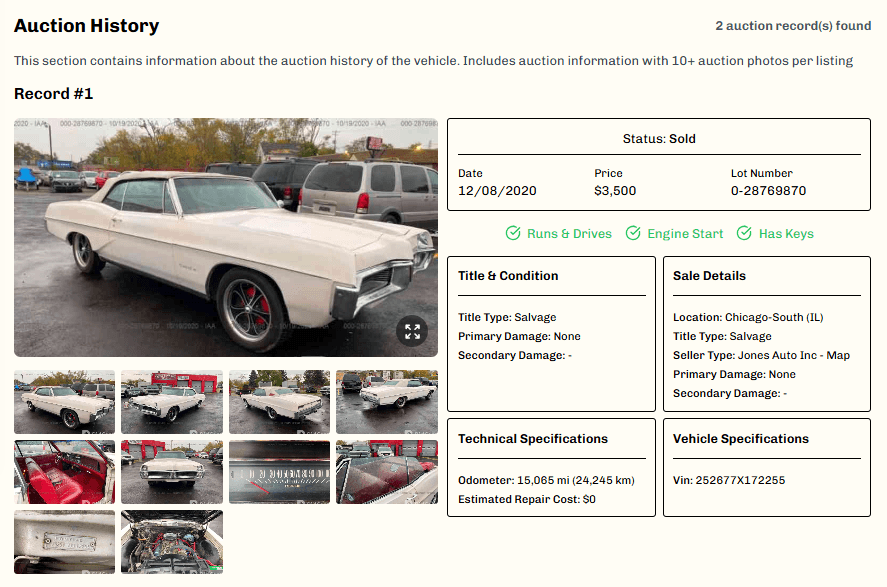
Our classic auction search by VIN pulls every available auction record tied to the vehicle and presents it in a clear, easy-to-read format. Here's exactly what you're expected to see.
Date Sold
The exact date the vehicle was sold at auction giving you a precise timeline of when it last changed hands publicly.
Amount Sold
The hammer price, what the car actually sold for at auction, before or after buyer's premium were recorded.
Lot Number
The assigned lot number from the auction, which can be used to cross-reference with auction house records if needed.
Sales Details
The name of the auction house, the sale event name, and the location where the transaction took place and was recorded.
Title and Condition
The title status at the time of auction, including any primary and secondary damage disclosures recorded by the auction house.
Odometer Reading
The mileage recorded at the time of the auction. This is a key data point for verifying the car's odometer history over time.
VIN Number
The full VIN confirmed at auction, allowing you to verify the number matches the car being offered for sale today.
Auction Photos
Where available, up to ten photos taken at the time of auction, representing an unfiltered visual record of the car's actual condition at sale.
What Other Information Is in a Full Auction VIN Report?
When you get the full classic vehicle history report, you get access far beyond auction records alone. Here are the complete details of what else you'll find when you purchase the full report.

Number of Previous Owners
See how many individuals or entities have held the title on this vehicle since registration records began.

Vehicle Usage
Find out whether the car served as a personal vehicle, rental unit, fleet vehicle, or commercial asset during its life.

Accident Records
View any reported collision events, including the severity of damage and whether structural repairs were recorded afterward.

Title History
See the full chain of title transfers, states of registration, and any brands like salvage, rebuilt, and more, applied to the title throughout the car's life.

Damage History
Check for disclosed damage events beyond collisions, including flood, fire, hail, rollover, and other insured damage incidents.

Theft Records
Find out whether the vehicle was ever reported stolen or returned as a recovered theft through law enforcement channels.

Mileage History
Review odometer readings logged across the car's life to verify accuracy and flag any potential discrepancy or rollback.

Lien and Loan Records
Check for outstanding financial claims attached to the title — an active lien can complicate or invalidate a private sale entirely.

Sales History
Access a record of past private and dealer sales events, showing how the car moved between owners over the years.
How to Check a Classic Car Auction VIN History
Checking a classic car's full auction history is instant, and the auction records and additional history data can be accessed through the classic vehicle history report. Here's how to get it.
- 1
Enter Your VIN
Type in the classic car VIN number into the search form at the top of the page, and submit to begin the lookup. - 2
Search VIN
Get an instant free VIN decoding showing the year, make, model, engine, and transmission, thus confirming you have the correct vehicle before proceeding. - 3
Get the Full Vehicle History Report
Unlock the complete report to access auction history, sale prices, condition photos, title records, accident history, theft data, mileage logs, and every other available record tied to that VIN.
Case Study: The Auction History Lookup That Got a Pontiac for $2,800
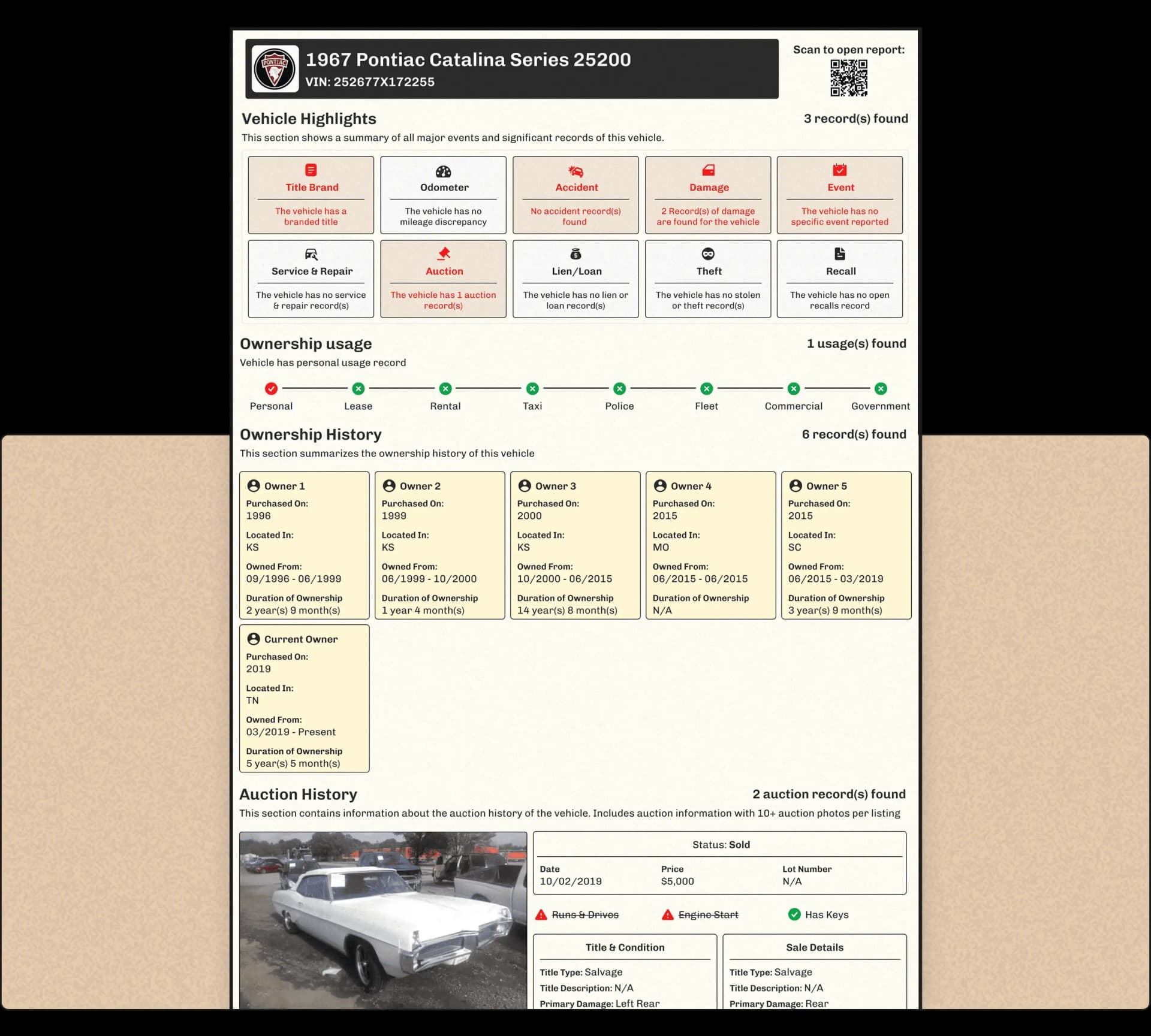
Daniel found a 1967 Pontiac Catalina listed for $5,000. The seller called it a fair deal. Daniel ran an auction VIN lookup to see what the car actually sold for before.
What the Report Showed
- ▶2 auction records
- ▶1 salvage branded title
- ▶Most recent auction price: $3,500
The Implication
The car sold for $3,500 at its last auction. The first auction had it at $5,000. The salvage title explained the big price drop.
How the Report Helped Daniel
Daniel showed the seller the auction history. He used the $3,500 sale to push the price down and got the car for just $2,800.
Why Choose Our Classic Car Auction VIN Check Tool?
Here's what makes our classic car VIN lookup service the right and best choice for serious classic car buyers, sellers, and collectors.
Trusted Data Sources
We retrieve auction records from verified, licensed auction data sources, and not estimates or unverified listings.
Updated and Verified Records
Our reports are populated with up-to-date auction history, giving you a richer, more recent picture of the vehicle.
Wide Classic Brand Support
We cover auction records for hundreds of classic makes and models, including pre-1981 vehicles with older VIN formats ranging from 5 to 14 digits.
24/7 Customer Support
Have a question about an auction result or an unusual VIN format? Our support team is available any time to help you get the right answer.
How to Buy a Classic Car at Auction
Buying a classic car at auction can be one of the most exciting and expensive experiences in the hobby. Here's how to approach it the right way and avoid costly mistakes.
- 1
Set a Hard Budget Before You Arrive
Decide your absolute maximum before you walk through the door or log on. Factor in the buyer's premium, which typically adds 10–15% on top of the hammer price at most major classic car auctions. - 2
Run a VIN Check on Every Car You're Considering
Pull the auction history, title records, and full vehicle history report on any car before you bid. What the catalog says and what the records show are not always the same thing. - 3
Inspect the Car in Person During Preview
Most auctions offer a preview period. Use it to look under the car, check panel gaps, examine the undercarriage for rust, and bring a flashlight. Photos in the catalog are always flattering, and reality may differ. - 4
Research Recent Comparable Sales
Check what similar examples sold for at recent auctions. Condition, options, and documentation all affect price significantly. E.g., A well-documented numbers-matching car can sell for double a stripped example of the same model. - 5
Understand the Terms Before You Bid
Read the auction house's terms of sale carefully. Know the buyer's premium rate, the payment deadline, and the vehicle collection window. Failing to collect a purchased vehicle on time can result in storage fees or forfeiture. - 6
Bid With Discipline, Not Emotion
Auction rooms and live online bidding are designed to create urgency and excitement. If bidding passes your pre-set limit, let it go. Another car will come. Overpaying at auction is one of the hardest mistakes to recover from in the classic car market.
Other Classic Vehicle Check Tools
Here are additional tools to help you find vital information and records on any classic car with 5 to 14-digit VINs.
Classic Car Title Check
Review title brands, liens, salvage records, and ownership issues before buying.
Classic Car Owner History Check
See previous owner count, location of registration, and duratin of ownership.

Check Any Classic Car Auction History in Seconds
Don't bid blind on a classic car. Run a classic auction VIN lookup right now and see the full sale history, condition records, and photos before you commit a single dollar.
FAQ About Classic Car Auction VIN Check
The most respected classic car auction houses include Barrett-Jackson, Mecum Auctions, RM Sotheby's, Bonhams, and Gooding & Company. Each specialises in different segments of the market, from affordable drivers to multi-million-dollar concours-quality collectibles.
To look up a pre-1981 VIN number, enter the VIN into our classic car VIN decoder to instantly retrieve the year, make, model, engine, and factory specifications. For a full history, ownership data, title brands, accident history, and more, pat the little amount to unlock the complete vehicle history report.
Classic car values have been mixed in recent years. After a sharp peak during 2021–2022, the broader collector car market softened through 2023 and into 2024, particularly for common muscle cars and post-war American vehicles.
Classic car values have been mixed in recent years. After a sharp peak during 2021–2022, the broader collector car market softened through 2023 and into 2024, particularly for common muscle cars and post-war American vehicles.
No. Auction photos show the vehicle at the time of that auction listing or sale. The car may have been repaired, restored, modified, damaged, repainted, or stored poorly after the auction.
Always compare old auction photos with current listing photos and inspect the car before bidding or buying.
No. A clean auction history only means no major auction issue or matching auction record was found in the available data. It does not guarantee that the vehicle has no title problems, accident history, rust, mechanical issues, odometer concerns, or hidden repairs.
Before bidding, verify the VIN, title status, auction history, odometer reading, ownership documents, lien records, damage history, and current vehicle condition. You should also read the auction terms carefully so you understand the buyer’s premium, payment deadline, transport rules, title transfer process, and storage fees.
For expensive classics, rare models, restored vehicles, and cars with limited paperwork, get a professional inspection before bidding.
No. Auction records may be incomplete because not every auction house, dealer auction, private sale, or older event is publicly reported or searchable by VIN.
If no auction record appears, it means no matching record was found in the available data, not that the car was never auctioned.
Auction prices are useful, but they may not show the full buying cost. The listed price may exclude buyer premiums, taxes, transport, storage, title fees, or post-sale repairs.
Use auction prices as a reference, then compare them with the car’s current condition, title history, mileage, photos, and recent similar sales.