
Instantly Check Classic Car Title by VIN
Before you buy any classic car, run a classic car title search by VIN first to know the status of the title or lien. Use our tool to find out whether a vehicle has a salvage-branded title that could affect its safety and value. Get the full history in seconds.


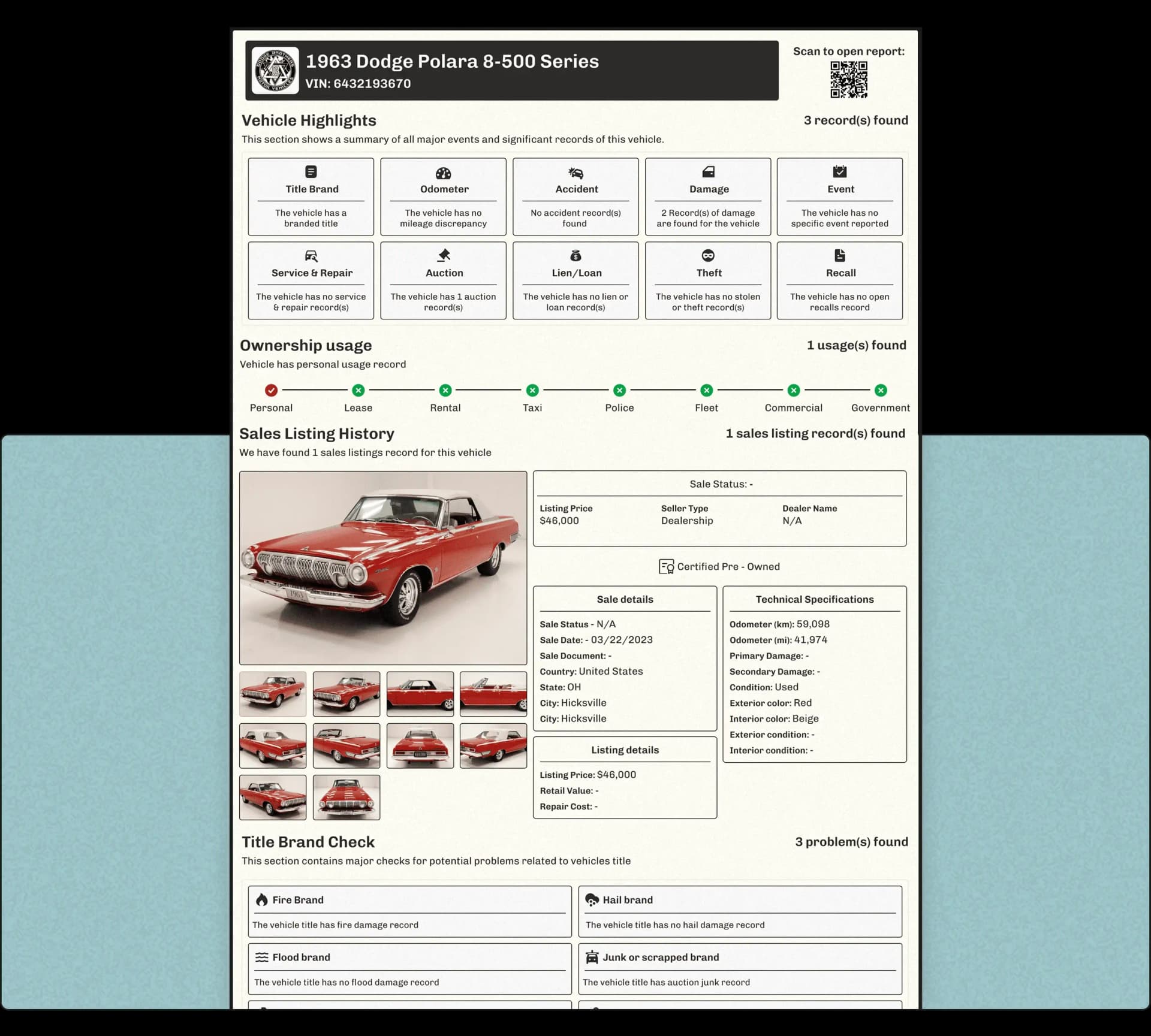
What Is a Classic Car Title Check?
A classic car title check is a search that reveals the official title status of a vehicle based on its VIN. It tells you whether the car carries any title brands, such as salvage, flood, rebuilt, or lemon, that could affect its value, insurability, or your ability to register and resell it legally.
This title check by VIN helps buyers avoid buying a car with a hidden legal or financial problem, and sellers can easily prove the car is clean and promote a fair price with confidence.
Why Check Classic Car Title Status Before You Buy or Sell
A title brand can cut a classic car's value by 20–80% overnight. Checking before the money changes hands protects everyone involved in the transaction. Here’s why it’s crucial:
Buyers
Buyers carry the most risk in any classic car deal, and a title check is the single fastest way to reduce that risk significantly.
Avoid Inheriting Someone Else's Legal Problem
A salvage or rebuilt title can make a car nearly impossible to insure at full value. Knowing the title status before purchase means you don't accidentally take on a problem the previous owner created.
Protect Your Investment Before You Pay
Classic cars are often significant purchases. A flood or junk title brand can wipe out resale value entirely. A two-minute title check could save you from paying full price for a car worth a fraction of that.
Ensure You Can Register and Resell the Car
Some title brands restrict how and where a vehicle can be registered. Others must be disclosed at resale. Knowing the title status upfront means no surprises at the DMV or when you eventually go to sell.
Sellers
Sellers benefit from a title check to help price fairly, sell faster, and protect themselves from disputes after the deal is done.
Know Exactly What You're Selling Before You List
If your classic car carries a title brand you weren't aware of, that will come out during the buyer's due diligence. Finding out first lets you price accordingly and avoid an embarrassing or deal-killing surprise.
Build Buyer Confidence With a Clean Report
Sharing a clean title check with your listing immediately separates you from sellers who offer no documentation. Buyers pay more and move faster with the purchase when they can see the title is clear.
Protect Yourself From Post-Sale Disputes
If a buyer later claims they were misled about the title status, a documented title check performed before the sale shows you acted in good faith and disclosed everything you reasonably could.
What Car Title Brands Does Our Tool Check For?
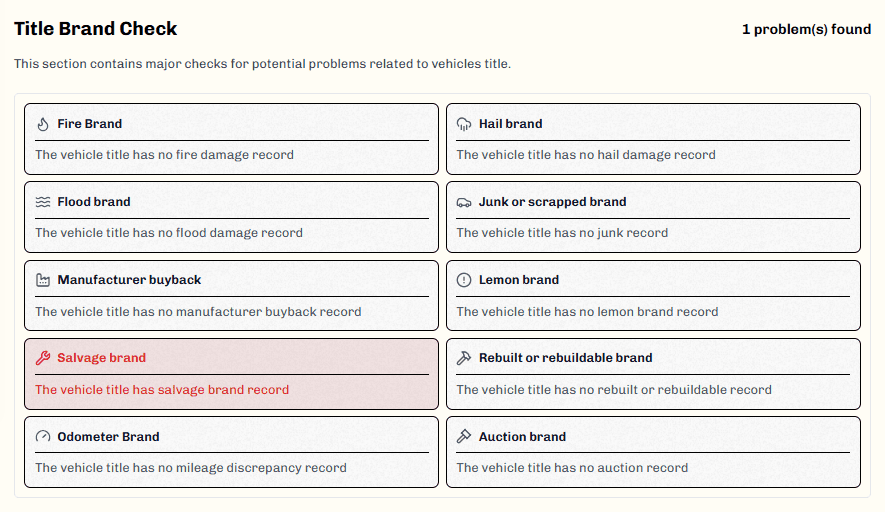
Our title check scans for every major brand category reported by state DMVs and insurance agencies across the United States, and here's what each one means.
Flood Brand
Assigned when a vehicle has been submerged in water to a level that reaches critical electrical or mechanical components.
Fire Brand
Issued when a vehicle has sustained damage from fire, whether engine-related, electrical, or from an external source.
Hail Brand
Applied when hail damage is severe enough to be reported to an insurer and officially recorded on the vehicle's title.
Junk or Scrapped Brand
Means the vehicle was declared beyond economical repair and officially designated for parts or scrap metal use only.
Salvage Brand
Issued when an insurer declares a vehicle a total loss, typically when repair costs exceed a set percentage of its value.
Rebuilt or Rebuildable Brand
Applied when a previously salvaged vehicle has been repaired and inspected to a standard that allows it back on the road.
Odometer Brand
Flags a vehicle where the odometer reading was found to be inaccurate, tampered with, or impossible to verify through records.
Lemon Brand
Issued in states with lemon law programs, where a manufacturer was required to buy back a defective vehicle from the original owner.
Manufacturer Buyback
Similar to a lemon brand, it’s recorded when an automaker repurchased a vehicle due to a defect, regardless of the state's lemon law status.
Auction Brand
Recorded when a vehicle was sold through an auto auction, particularly relevant for fleet, rental, or insurance settlement vehicles.
What Does the Full Classic Car Title Check Report Reveal?
The full vehicle history report shows more than the title brands alone. It gives you a complete record of everything that happened to that car throughout its recorded life. These include:

Number of Previous Owners
See exactly how many individuals or businesses have held the title on this vehicle since records began.

Vehicle Usage
Find out whether the car was used as a personal vehicle, rental fleet unit, taxi, or commercial vehicle during its life.

Accident Records
View reported collision events, including severity and whether the damage affected the vehicle's structural integrity.

Damage History
Check for disclosed damage events beyond accidents, including fire, water intrusion, rollover, and hail damage on record.

Theft Records
Find out whether the vehicle was ever reported stolen or flagged as a recovered theft by law enforcement agencies.

Mileage History
Review odometer readings logged over time to verify mileage accuracy and identify any potential rollback or discrepancy.

Lien and Loan Records
Check for any outstanding financial claims attached to the title. Buying a car with an active lien can put your ownership at risk.

Sales History
Access a timeline of past private sales and dealer transactions, showing how the car moved through the market over time.

Auction History (with Photos)
See if the car appeared at any auctions, including classic car auctions, with available condition photos and sale results.
How to Check a Classic Car Title and History
Checking a classic car's title status and full history is instant with our tool. The title records and all other history data can be accessed through the full vehicle history report. Follow these simple steps:
- 1
Enter Your VIN
To begin, locate the classic car VIN number on the car or in the legal documents, and enter into the form at the top of the page. - 2
Search VIN
Click “Decode Classic VIN” to decode and preview the year, make, model, engine, and transmission. This confirms you have the right vehicle before proceeding. - 3
Get the Full Vehicle History Report
Unlock the complete report to check title brands, accident records, theft history, mileage data, ownership records, and every other available file on that VIN.
Case Study: How a Title Check Exposed a Salvage Pontiac Deal
Tom wanted a 1967 Pontiac Catalina he found for sale. The seller said it was a good car with a clean history. But Tom had one rule: no salvage cars. He ran a classic car title check to be sure.
What the Report Showed
- ▶A salvage brand record
- ▶2 auction records
- ▶Title held by an insurance company
What This Implies
A car titled to an insurance company usually means it was in a bad accident or flood. Two auction records made things look even worse.
How the Report Helped Tom
Tom walked away. The title search by VIN saved him from buying a car with a hidden past he never wanted.
Why Use Classic Decoder for a Classic Car Title Search?
There are other title check tools out there, but here's why thousands of classic car buyers and dealers trust ours for accuracy and comprehensiveness.
Trusted Data Sources
We pull from state DMV records, NMVTIS, and licensed insurance databases, not user-submitted, unverified information.
Factory-Authentic Records
Our data cross-references manufacturer records alongside title history, giving you more complete records than standard title tools offer.
Wide Classic Brand Support
We provide title searches for hundreds of classic makes that are of American, European, and Japanese origin, including pre-1981 vehicles with older VIN number formats.
24/7 Customer Support
Have a question about your title history report or need help with decoding your 5-14 digit VIN? Our support team is available to help anytime.
How to Get a Title for a Classic Car
If you already own a classic car with a missing or lost title, you still have options. Here are practical steps for getting a replacement title in the US.
- 1
Check With Your State DMV
Visit or contact your state's Department of Motor Vehicles. Most states allow you to apply for a duplicate or replacement title if the car was previously registered in your name. - 2
Apply for a Bonded Title
If the title was never transferred to your name, many states allow you to obtain a bonded title, which is a surety bond that acts as a substitute title and protects future buyers from ownership disputes. - 3
Pursue a Court-Ordered Title
In cases where a bonded title isn't available or the ownership history is disputed, a court-ordered title is the next option. A judge can legally establish your ownership based on the evidence you present. - 4
Use a Title Service Company
Licensed title service companies specialise in navigating the paperwork for exactly this situation. They know state-by-state requirements and can often resolve missing title issues faster than going it alone.
The Best Way of Buying a Classic Car Without a Title
Buying a classic car without a title is possible, but it requires extra caution. Here's how to protect yourself if you're considering it.
Run a VIN check before anything else
Verify the car isn't stolen, salvaged, or flagged with a lien before any money changes hands.
Ask the seller for a bill of sale
A signed, notarised bill of sale is not a title replacement, but it does establish a paper trail for your ownership claim.
Research your state's bonded title process
Most states offer a clear path to titling an untitled vehicle. Know that process before you commit to the purchase.
Check if the seller can obtain a duplicate title first
If the car was previously titled in the seller's name, they can often request a duplicate from their state DMV before the sale.
Never pay full market value for an untitled car
The time, cost, and uncertainty of resolving a missing title are real. Ensure to price that risk into your offer from the start.
Avoid cars with unclear or disputed ownership history
If the seller can't explain why there's no title, that's a signal to walk away rather than take on an unknown legal situation.
Other Classic Vehicle Check Tools
Here are additional tools to help you find vital information and records on any classic car with 5 to 14-digit VINs.
Classic Car Auction History Check
Review past auction history, date sold, photos, and sales details by VIN.
Classic Car Owner History Check
See previous owner count, registration history, and ownership timeline details.

Verify Any Classic Car Title History Before Buying
Don't hand over money on a classic car without knowing its title history. Run a classic car title search by VIN and reveal any hidden records before you commit.
FAQ About Classic Car Title Search by VIN
Title records for classic cars can vary by state and era. Records are much less accurate and detailed compared to modern cars. The data became more reliable for vehicles registered after the mid-1980s, when digital DMV systems became widespread.
Yes. Pre-1981 vehicles used shorter, manufacturer-specific serial numbers rather than the standardised 17-digit VIN. Classic Decoder’s VIN decoder is built to handle these older formats across a wide range of classic makes.
Start by running a VIN check to confirm the car isn't stolen or liened. Then explore your state's bonded title or duplicate title process, or consider Vermont's registration-to-title program. A licensed title service company can also guide you through the fastest legal route available.
Yes, significantly. A car with a salvage, flood, or lien brand can be worth far less than its asking price, difficult to insure, and complicated to resell. Undisclosed title problems are one of the most common and costly mistakes classic car buyers make.
Do not complete the purchase until the mismatch is explained with official documentation. VIN mismatches can happen because of clerical errors, replaced parts, restoration work, state-assigned VINs, or more serious ownership issues.
No. A clean title search means no major title issue was found in the available records searched. It does not guarantee that the vehicle has never been damaged, repaired, restored, repainted, stolen, or involved in an undocumented accident. Always combine a title search with a physical inspection and document review.
No. A clean title search means no major title issue was found in the available records searched. It does not guarantee that the vehicle has never been damaged, repaired, restored, repainted, stolen, or involved in an undocumented accident. Always combine a title search with a physical inspection and document review.
A classic car title search uses available vehicle records from title, insurance, salvage, auction, and government-related databases. Depending on the VIN and available records, the search may show title brands, lien records, theft records, mileage history, accident records, damage history, auction records, and ownership details.
For older classic cars, especially pre-1981 vehicles with shorter VINs, the amount of available data can vary. Some records may be limited because many older vehicles were bought, sold, registered, or restored before digital vehicle records became common.