
Marti Report vs Reconstructed Build Sheet: What's the Difference?
A Build Sheet, whether an original factory document or a reconstructed report, details how a vehicle was configured when it left the factory. But not all build documentation is the same thing, and treating “Marti Report” and “Build Sheet” as interchangeable terms leads to a frustrating and often costly mistake.
Here is the essential distinction: a Marti Report is a data report generated directly from Ford Motor Company's original production database, accessed under license by Marti Auto Works, and it is generally available only for Ford, Lincoln, and Mercury vehicles built in the United States or Canada from model year 1967 onward. A reconstructed Build Sheet, such as the one offered by Classic Decoder, is a factory-configuration report inferred from available historical identifiers and documentation rather than extracted from that same database. Classic Decoder's coverage extends from 1910 through 1981, which means it reaches vehicles that predate the Marti eligibility window.
Vehicle year is the primary routing variable. If your vehicle is a 1968 Ford Mustang, a Marti Report is generally available for it. If your vehicle is a 1965 Ford Mustang, it predates the database coverage that Marti Auto Works licenses, and a Marti Report is generally not an option. A reconstructed Build Sheet becomes the available documentation path in that case.
One boundary applies to both products equally: neither a Marti Report nor a reconstructed Build Sheet proves that your vehicle currently has its original engine, drivetrain, or components. Both documents describe original factory configuration. Physical condition today is a separate matter that requires a separate evaluation.
A Marti Report is one of several ways to research a classic vehicle's original factory configuration, but it is not the same as a reconstructed Build Sheet. For a broader look at the main documentation choices and when each one makes sense, see Classic Car Build Sheet Options & Alternatives Explained.
What Is a Marti Report?
A Marti Report is an archive-derived data report generated from Ford Motor Company's original production database. Marti Auto Works, operating under license from Ford, produces these reports by querying the factory records for a specific vehicle's serial number. That database reflects how Ford constructed the vehicle at the point of manufacture, capturing the options, packages, and specifications encoded at the factory for that particular serial number.
Because the report draws on Ford's own production records, it carries the data authority of the original manufacturing source. Marti Auto Works is the licensed issuer of these reports, not a third-party estimator or a company reconstructing information from secondary sources.
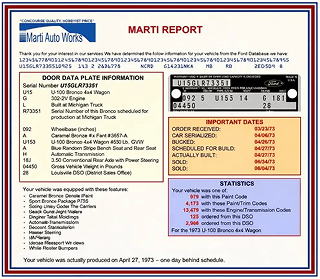
What the report covers is precisely what Ford recorded at the time of production for that vehicle. Dealer-installed accessories added after the car left the factory are outside the scope of the report. Modifications made by subsequent owners are equally outside scope. The document is a record of original factory intent for that serial number, not a history of everything that has ever happened to the vehicle.
Marti Reports are currently available in multiple tiers, including Standard, Deluxe, and Elite options, each offering varying levels of detail and reproduction documents. Higher tiers generally provide greater depth and may include facsimile copies of relevant factory records. The exact contents and pricing of each tier are subject to change by Marti Auto Works, so the tier structure here is described at a conceptual level rather than as a binding specification.
A Marti Report is also not a physical document retrieved from a filing cabinet. It is a report generated from a digital database. The authority it carries comes from the licensed database itself, not from the survival of a physical paper original.
Physical condition verification falls outside what any factory configuration document can establish. That boundary is significant enough to warrant its own dedicated discussion later in this article.
Which Vehicles Each Report Covers and Why That Matters
Choosing between a Marti Report and a reconstructed Build Sheet begins with one question: what year was your vehicle built? The answer determines which documentation path is technically available to you, and understanding why the eligibility rules differ explains what kind of evidence each document actually represents.
- Marti Report: 1967 onward (Final verified range)
- Classic Decoder Reconstructed Build Sheet: 1910 - 1981
- Reconstructed from available historical evidence
- Licensed Ford production data
Marti Report Eligibility: The 1967 Database Boundary
Marti Reports are generally available for Ford, Lincoln, and Mercury vehicles built in the United States or Canada from model year 1967 onward. That eligibility boundary is not a product limitation or a deliberate restriction by Marti Auto Works. It reflects a historical data availability reality: Ford’s production records from earlier model years generally did not survive in a centralized, digitized form compatible with the Marti Report system. The database that Marti Auto Works licenses begins with the 1967 model year because that is where the surviving centralized records begin.
The practical consequence of that boundary is straightforward. An owner of a 1968 Ford Mustang can generally order a Marti Report and receive a factory-sourced data extraction for their vehicle’s serial number. An owner of a 1965 Ford Mustang cannot, because that vehicle predates the database coverage that Marti Auto Works licenses. The 1965 Mustang simply does not have a corresponding entry in the Ford production database that Marti draws upon. No amount of searching changes that fact because the records from that era did not survive in the required form.
This means a meaningful portion of classic Ford owners, including owners of many of the most collectible vehicles from the early and mid-1960s, have no access to a Marti Report regardless of how desirable their car is or how well-documented its ownership history may be. The boundary is determined by database survival, not by model popularity or historical significance.
The Pre-1967 Documentation Gap
For owners, buyers, sellers, and researchers working with pre-1967 Ford, Lincoln, and Mercury vehicles, the absence of a Marti-compatible database entry creates a real documentation gap. There is no Marti Report to order. There is no licensed Ford database record to draw upon. Anyone seeking factory-configuration documentation for a 1965 Mustang, a 1963 Galaxie, or a 1960 Thunderbird faces a situation where that primary evidence source simply does not exist.
This gap is not a failure of any particular documentation product. It is a consequence of how manufacturing records from that era were kept and which of those records survived. The gap affects everyone working with those vehicles equally.
An alternative documentation path does exist for pre-1967 vehicles, and it is worth understanding what that path is, how it works, and what it realistically delivers.
Classic Decoder’s Reconstructed Build Sheet: Coverage and Source Basis
Classic Decoder offers a reconstructed Build Sheet, which is a factory-configuration report assembled from available historical identifiers and documentation rather than extracted from Ford’s original production database. Classic Decoder is an independent provider and is not affiliated with Marti Auto Works. Classic Decoder does not issue Marti Reports.
The distinction in source method matters. Where a Marti Report draws on Ford’s centralized production database under license, Classic Decoder’s reconstructed Build Sheet infers the vehicle’s original factory configuration from historical evidence available for that vehicle. The result is normally a reconstructed factory-configuration report, not an original manufacturer-issued document and not an archive database extraction.
Classic Decoder specializes in classic and pre-1981 vehicles, with primary coverage spanning 1910 through 1981 and supporting VIN lengths of 5 through 17 characters. That coverage range directly addresses the pre-1967 gap that Marti Report eligibility leaves open. A 1965 Mustang owner who cannot obtain a Marti Report can pursue a reconstructed Build Sheet as the available alternative documentation path.
However, accurate expectation-setting is important here. Reconstruction relies on the historical evidence that exists for a given vehicle. Completeness varies depending on the vehicle and the records that have survived. A reconstructed Build Sheet may not capture 100 percent of every factory option code for every vehicle. The depth and completeness of any individual report are shaped by what historical documentation is available for that specific vehicle, not by a guaranteed comprehensive coverage standard.
| Feature | Marti Report | Reconstructed Build Sheet |
|---|---|---|
Source Provenance | Ford’s original production database (licensed via Marti Auto Works) | Available historical identifiers and documentation (reconstructed; not extracted from Ford’s database) |
Vehicle Year Coverage | Generally 1967+ US and Canadian-built Ford, Lincoln, Mercury | 1910-1981 (pre-1981 specialized); 5-17 character VINs |
Issuer | Marti Auto Works (licensed by Ford Motor Company) | Classic Decoder (independent provider; not affiliated with Marti Auto Works) |
Primary Deliverables | Multiple tiers (Standard, Deluxe, Elite); varying detail; may include reproduction documents (tier contents subject to change) | Reconstructed factory-configuration report based on available evidence (completeness varies by vehicle and surviving records) |
Proves Physical Originality? | No | No |
The table above gives you a side-by-side reference, but a few points are worth stating plainly to use it correctly.
On vehicle year coverage: the Marti Report row reflects a genuine historical boundary, not a product choice. If your vehicle predates 1967, the Marti column is not available to you regardless of which tier you might prefer. The Classic Decoder row covers a broader range, but the completeness of any individual reconstructed report depends on available historical evidence.
On source provenance: these are categorically different evidence bases. A Ford database extraction under license and a reconstruction from available historical documentation are not equivalent in source authority. Both have legitimate roles, but they are distinct methodologies.
On physical originality: both columns read “No.” That is not a limitation specific to either product. It reflects a boundary that applies to all factory configuration documentation, and it is important enough to address directly.
Uncover Your Classic Car's History or Build Sheet in 3 Easy Steps
- 1
Enter VIN
Input the unique VIN of your classic car. - 2
Select Report
Select Vehicle History, Build sheet, or both. - 3
Access Data
Receive comprehensive reports and build sheets instantly.
What Neither Document Can Tell You About Your Car Today
Neither a Marti Report nor a reconstructed Build Sheet proves that your vehicle currently has its original engine, original drivetrain, or any of its original components.
This is not a flaw in either product. It is a straightforward distinction between two categorically different things: what a car was built as, and what a car currently is. A factory configuration document is a historical record. It describes what Ford intended and recorded for that serial number at the time of manufacture. It says nothing about the physical state of the vehicle sitting in front of you today.
A vehicle can have a complete, accurate Marti Report and a replaced engine. It can have a well-researched reconstructed Build Sheet and a repainted body. Documentation describes original factory configuration. It does not monitor, track, or verify what has happened to a vehicle in the decades since it left the factory.
Important boundary:
Factory configuration documentation and physical vehicle condition are separate categories of information. Confirming that a vehicle currently has its original engine, matching components, or unmodified drivetrain requires a separate in-person physical inspection. Neither a Marti Report nor a reconstructed Build Sheet is a substitute for that inspection, and no variant of either document certifies current physical condition.
This boundary applies universally to both products, with no exceptions. Dealer-installed options added after the vehicle left the factory are outside the scope of factory configuration records. Post-production modifications of any kind are equally outside scope. And the current physical state of any component is entirely outside what any factory documentation can establish.
For buyers evaluating a classic Ford for purchase, this distinction has real financial consequences. Factory documentation is a useful and legitimate research tool. It tells you what the car was supposed to have when it was built. Verifying whether those components are actually present, unmodified, and original requires a qualified physical inspection as a separate and necessary step.
Interested in buying a classic car or selling one?
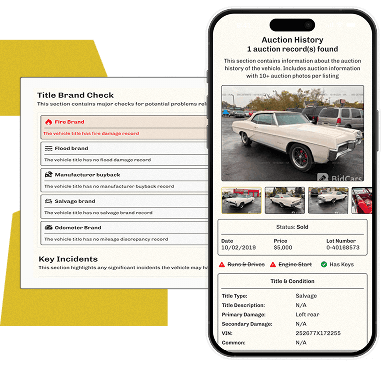
Access detailed history reports for classic vehicles from hundreds of manufacturers.
- ▶Accident Records
- ▶Theft Records
- ▶Loan & Lien Information
- ▶Auction Information
- ▶Salvage Information and more.

What Our Customers Say About ClassicDecoder?
We have helped a lot of people make smarter decisions about classic cars. Here are a few stories straight from the individuals who used our tools.
It was very easy for me to obtain the information I needed in regards to my vehicle I am looking to sell. In a world of buyer beware it helps put potential buyer at ease to see the report confirming the information I have given him. This service is fairly priced which was another advantage. SB Samuel Bonacci Aug 24, 2024•US | |||
Very outstanding service! I had a few difficulties on my end and the rep jumped on it, fixed my issue and even through in another discount. There is nothing better than that kind of service. I will be getting all of my future reports from them, hands down the best. JA Jim A. Jan 10, 2025•US | |||
This site had great options for a variety of products that we could want to support our needs of reports. Was delivered via email and downloadable from the website for optimal convenience in the most helpful formats. E Erik Jan 19, 2025•US | |||
Sam Adams provided me with the best experience. He was patient and walked me through getting the report and window sticker for my vehicle. I really appreciate his service… It has been refreshing. RF RICH FLORES Jan 14, 2025•US | |||
It was very easy for me to obtain the information I needed in regards to my vehicle I am looking to sell. In a world of buyer beware it helps put potential buyer at ease to see the report confirming the information I have given him. This service is fairly priced which was another advantage. SB Samuel Bonacci Aug 24, 2024•US | Very outstanding service! I had a few difficulties on my end and the rep jumped on it, fixed my issue and even through in another discount. There is nothing better than that kind of service. I will be getting all of my future reports from them, hands down the best. JA Jim A. Jan 10, 2025•US | This site had great options for a variety of products that we could want to support our needs of reports. Was delivered via email and downloadable from the website for optimal convenience in the most helpful formats. E Erik Jan 19, 2025•US | Sam Adams provided me with the best experience. He was patient and walked me through getting the report and window sticker for my vehicle. I really appreciate his service… It has been refreshing. RF RICH FLORES Jan 14, 2025•US |
FAQ About Marti Report
A Marti report is an official document from Marti Auto Works that lists factory build details for classic Ford, Lincoln, and Mercury vehicles made between 1967 and 2017. It verifies the vehicle specifications, originality, and rarity.
You can get a Marti report by ordering directly from the Marti Auto Works website. You will be required to enter your vehicle’s details. Marti Reports are usually sent as a PDF to your email, so you can easily view or print them. If you want a paper copy mailed to you, just choose the print service option. For more detailed vehicle information and records than what the official Marti auto report reveals, simply use Classic Decoder’s classic car VIN lookup tool.
Marti reports cover vehicles built from 1967 to 2017. Earlier models may not have complete factory records, but limited decoding services are available for those vehicles. For years that weren’t covered and for detailed vehicle information, you should consider getting our classic build sheet by VIN.
Yes. For collectors, restorers, or sellers, it’s proof of authenticity. A verified factory record boosts confidence, enhances restoration accuracy, and can increase resale value.
Marti reports are said to be accurate. They use original Ford production microfilm data, making them the most reliable source of factory information for classic Fords. The data is officially licensed by Ford Motor Company.
Marti Auto Works offers several levels of Marti Reports, namely: Standard, Deluxe, and Elite. Each provides more vehicle factory build details and production history. They also offer personalized statistics reports and authentic build sheet reproductions for selected models, giving enthusiasts a clearer picture of their car’s original specifications and rarity.
No, Marti reports aren’t free. They’re a paid service available for Ford, Lincoln, and Mercury vehicles produced between 1967 and 2020. Prices typically range from around $18 to over $220, depending on the depth of information and report type you choose.
A standard Marti report usually arrives within 5–14 days, depending on the vehicle’s model and rarity. Most 1967–1979 cars take 5–7 days, while rarer models, trucks, and later models may take 10–14 days. Rush service is also available for an extra fee.
Not exactly the same. A Marti Report draws on Ford's own licensed production microfilm for Ford, Lincoln, and Mercury vehicles from 1967–2017. It's an archival record for the vehicles it covers. ClassicDecoder's build sheet compiles available VIN-decoded and historical data across 500+ makes and all years, which gives you broader coverage but isn't sourced the same way.
Need factory-configuration research for a vehicle outside Marti eligibility?
Classic Decoder offers reconstructed Build Sheet research for classic and pre-1981 vehicles within supported coverage.