
Classic Truck VIN Decoder: Check Specs, Engine & More
Use our classic truck VIN decoder to instantly look up the full specifications of any pre-1981 truck, including the year, model, trim, engine, transmission, fuel type, and more. It takes seconds and starts completely free.


What Is a Classic Truck VIN Decoder?
A classic truck VIN decoder is a tool that reads the serial number, or VIN, stamped on an old truck and translates it into the vehicle's original factory specifications. It tells you exactly what the truck was built as, such as the engine size, transmission type, axle configuration, and more.
A 1972 Chevrolet C10 and a 1972 C20 can look nearly identical in a photo, but they're very different trucks under the skin. Correctly decoding the VIN helps confirm which one you're actually dealing with, and this can save you from buying the wrong truck or ordering the wrong parts for a restoration.
Where Can I Find the VIN on an Old Truck?
Finding the VIN on old trucks is not always easy. Aside from checking the title and registration, here are common places to check for your truck’s VIN or the one you’re considering:
- ▶Driver's Side Door Jamb: Check the sticker or stamped plate on the door frame. This is a common location on trucks built after the mid-1960s.
- ▶Dashboard, Driver's Side (Visible Through Windshield): On many 1968 and newer trucks, the VIN plate sits on top of the dash, visible through the glass from outside.
- ▶Firewall (Engine Compartment): Look for the stamped or riveted VIN on the firewall, the metal wall between the cab and the engine.
- ▶Frame Rail: On heavy and medium-duty classic trucks, the VIN or serial number is frequently stamped directly onto the driver's side frame rail near the front.
- ▶Door Hinge Pillar: Some manufacturers placed the identification plate on the hinge pillar, which is the structural post that the door hinges attach to.
- ▶Engine Block or Transmission: Partial VINs or engine codes are often stamped on the engine block or transmission case.
What Can You View with a Free Truck VIN Decoder?
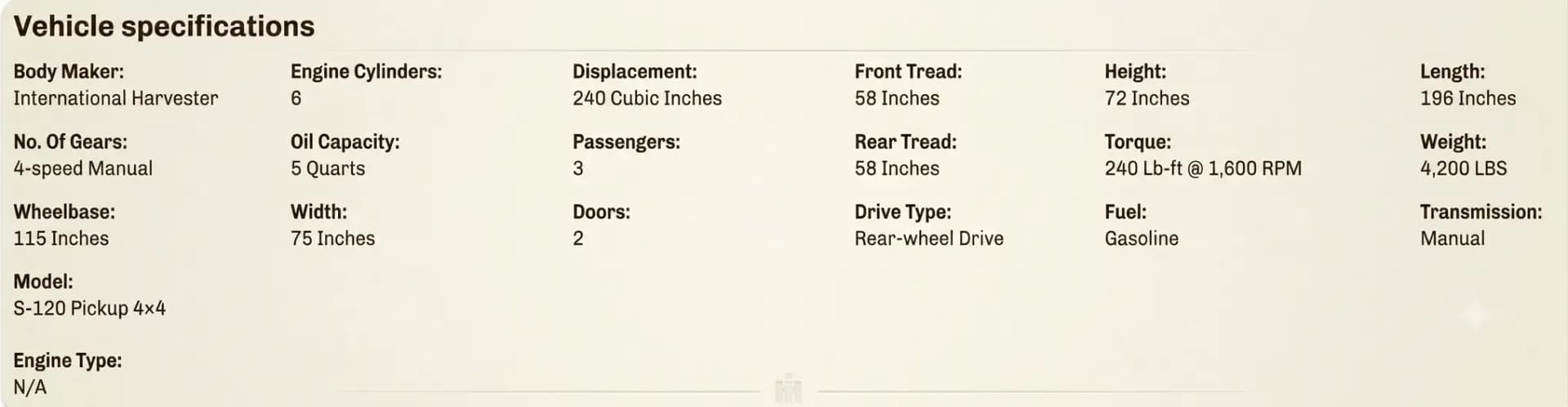
A free classic truck VIN decoder gives you the core factory specifications for any pre-1981 truck, all in a matter of seconds, and at no cost. Here’s what you’ll get:
Year, Make, Model
Instantly confirm the exact production year, manufacturer, and model designation the truck left the factory with.
Transmission
See whether the truck was built with a manual or automatic transmission and the specific unit type.
Engine Details
Decode the original engine, like displacement, cylinder count, configuration, and fuel delivery system fitted at the factory.
Drive Type
Find out whether the truck was factory-built as a two-wheel drive, four-wheel drive, or an all-wheel-drive configuration.
Number of Gears and Doors
View the number of forward gears in the original transmission and the door configuration of the cab.
Axle Type
See the factory axle type and ratio. This is critical information for restoration, towing capacity verification, and parts sourcing.
Fuel Type and Capacity
Confirm whether the truck was built for gasoline, diesel, or an alternative fuel, along with the factory fuel tank capacity.
Body Measurements (Weight, Length, etc.)
Access factory body dimensions, including gross vehicle weight rating (GVWR), overall length, wheelbase, and payload capacity.
Wheels, Rims, and Tires
View the original factory wheel size, rim type, and tire size specification the truck was fitted with at production.
How to Decode a Classic Truck VIN Number
Decoding a classic truck VIN is fast and simple. Enter the number, and the decoder pulls the original factory specifications in moments.
- 1
Enter and Submit Your VIN
Type the full VIN or pre-1981 serial number into the form at the top of the page and hit submit to begin the decoding instantly. - 2
View the Classic Truck Specs for Free
Your results appear immediately, including the year, make, model, engine, transmission, drive type, axle, and all available factory specifications at no charge.
What Does a Full Truck VIN Check Reveal?
Beyond factory specifications, a full VIN check pulls the truck's complete recorded history, including everything that happened to it after it left the factory floor. Expect to see the following records:

Number of Previous Owners
See how many individuals or businesses have held the title on this truck since records began.

Vehicle Usage
Find out if the truck was used as a personal vehicle, commercial fleet unit, or government vehicle during its life.

Title Brand Status
Check for salvage, rebuilt, flood, or lemon law title brands that could affect value, insurability, and resale.

Accident Records
View any reported collision events, including severity level and whether structural damage was recorded at the time.

Damage History
See detailed damage disclosures beyond accidents — including fire, hail, water intrusion, or rollover events on record.

Theft Records
Find out if the truck was ever reported stolen or flagged as recovered, which can complicate title transfers.

Mileage History
Review odometer readings logged across the truck's life to verify mileage accuracy and flag potential rollback issues.

Lien and Loan Records
Check for any outstanding financial claims or unpaid loans still attached to the truck's title before purchasing.

Sales History
Access a timeline of past private and dealer sales, showing how the truck moved through the market over time.

Auction History (with Photos)
See if the truck appeared at any auto auctions, including classic truck auctions, with available condition photos and results.
How to Get a Classic Truck History Report
Getting a full history report for a classic truck takes three straightforward steps. You'll have the complete record ready to view and download as a PDF.
- 1
Enter Your VIN
Type the truck's full VIN into the search form at the top to begin the lookup process. - 2
Search VIN
Review the free decoded specs, including the year, make, model, engine, and configuration, to confirm you have the right vehicle before proceeding. - 3
Get the Truck History Report
Complete a simple payment to unlock, view, and download the full classic truck history report as a PDF, which becomes yours to keep for future records.
The Importance of Looking Up Classic Truck Records
Whether you're buying, selling, or restoring, a classic truck VIN check gives you facts instead of assumptions, which helps protect your money and investment. Here are some benefits of running a classic truck VIN lookup:
Buyers
For buyers, running a VIN check before purchasing a classic truck is one of the simplest ways to avoid a costly and stressful mistake.
Be Aware of Problems the Seller Didn't Mention
Accident history, flood damage, and salvage titles don't always come up in conversation. A classic truck VIN check brings those records to the surface before you hand over any money.
Confirm the Truck Matches What's Advertised
Sellers sometimes mislabel a truck's engine, trim, or configuration by accident or by design. The classic truck VIN decoder helps confirm the factory specifications so you can verify the listing is accurate.
Avoid Trucks With Hidden Title Problems
A truck with a branded title or an unresolved lien can cause serious legal and financial headaches after purchase. A full VIN check reveals those issues before the deal closes.
Sellers
For sellers, having a clean, documented VIN report on hand makes the truck easier to price, easier to sell, and less likely to fall through at the last moment.
Set a Confident and Defensible Asking Price
Knowing the factory specifications and the truck's documented history lets you price it accurately, and back up that price with evidence when buyers push back.
Build Instant Credibility With Serious Buyers
Sharing a vehicle history report with your listing signals transparency. Serious classic truck buyers take that as a strong sign the seller has nothing to hide about the vehicle.
Reduce the Chance the Deal Falls Through
Most sales collapses happen when a buyer discovers something unexpected late in the process. A clean, upfront truck history report removes surprises and keeps the deal on track.
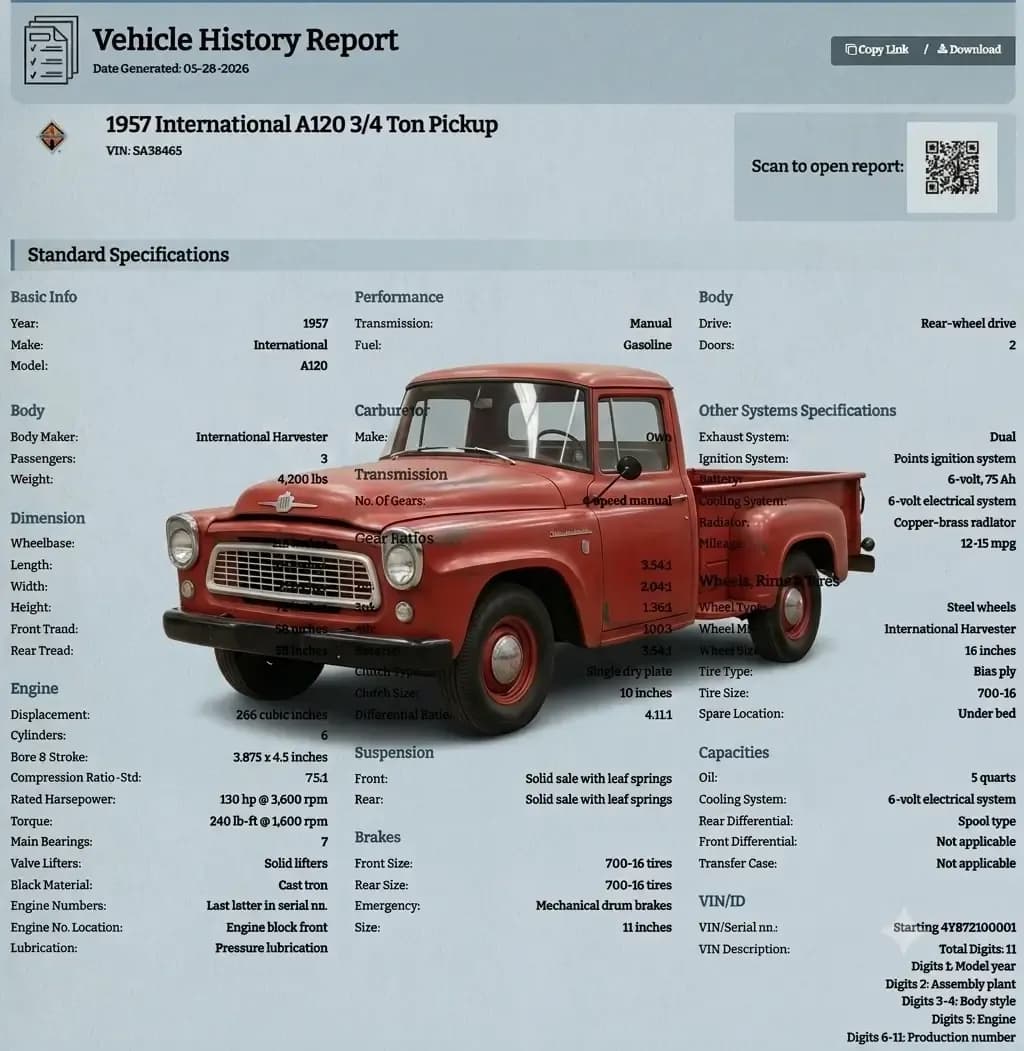
Case Study: How a Buyer Confirmed the Truth About a 1957 Pickup
A buyer found a 1957 International A120 3/4 Ton Pickup listed for sale and liked its clean look. The seller claimed it was a solid classic with no major problems. Before making an offer, the buyer looked up the VIN to confirm the details and avoid an expensive mistake.
What the Report Revealed
The report matched VIN SA38465 and confirmed the following:
- ▶The last seller as eBay Motors
- ▶The odometer was marked as exempt
- ▶No accident record
- ▶No theft record was found
Possible Past Incidents and Condition
The report did not show any reported accidents or theft history. While older trucks can have hidden repairs, there were no records pointing to major past damage.
How the VIN Lookup Helped
The chassis number check gave the buyer more confidence to move forward. It backed up key claims about the truck and helped the buyer make a smarter decision before spending money.
Free VIN Decoder vs. Paid VIN Check: When Each Tool Matters
A free classic truck VIN check tool is the right starting point for anyone who wants to confirm what a truck is before going further. It tells you the factory specs, like year, make, model, engine, transmission, and drive type at no cost. The free decode helps with researching a model, checking a listing's claims, or sourcing parts for a restoration.
A paid classic truck VIN search pulls the truck's recorded life history, like previous owners, accident reports, title brands, mileage records, theft flags, and auction appearances. If you're about to spend real money on a classic truck, this report is the tool that protects you and your money.
Why Choose Our Classic Truck VIN Decoder and Lookup Tool?
Here's why thousands of buyers, collectors, restorers, and dealers trust our platform when they need accurate classic truck VIN data.
Trusted Data Sources
We pull from verified DMV records, manufacturer databases, and licensed data sources.
Factory-Authentic Records
Our classic vehicle data reflects original manufacturer production records, giving you the most accurate factory specification available for pre-1981 trucks.
Wide Classic Brand Support
We support VIN lookups for hundreds of classic truck makes, including American, international, and specialty brands from the pre-1981 era.
24/7 Customer Support
Have a question about a confusing VIN result or an older serial number format? Our support team is available around the clock to help.
Popular Classic Truck Makes, Years & VINs We Support
Below is a list of popular classic truck makes, model years, common VIN lengths, and sample VIN formats by year range, covering classic trucks built before 1981.
Year Range | Popular Classic | Common VIN Format | Sample VIN |
1930s–1940s | Dodge Brothers trucks, Ford trucks, Chevy trucks, International KB trucks, Willys trucks | Short serial-style VINs | 93005230 |
1950s | Chevy 3100, Ford F-Series, Dodge/Fargo trucks, International L/R-Series, Willys Jeep trucks | Short VIN formats | 84270185 |
1960–1966 | Chevy C/K trucks, Ford F100/F250, Dodge D-Series, International C-Series, Jeep Gladiator | 8-12 characters | 1412282334 |
1967–1972 | Chevy/GMC C10/K10, Ford F100/F250, Dodge D100/D200, International pickup trucks, Jeep trucks | 10-13 characters | F10YRH12345 |
1973–1980 | Chevy/GMC square body trucks, Ford F-Series, Dodge D/W-Series, Jeep J-Series, International Scout/Travelall, Mack, Kenworth, Peterbilt | 13-17 characters | D14BE6S285524 |
Get Build Sheets for Classic Truck
A classic truck build sheet is the factory's original production record for your specific vehicle that lists every specification and option that was ordered and installed the day that truck was built. It includes the engine, transmission type, axle ratio, cab configuration, pant colour, and more.
The build sheet can help differentiate between identical classic truck models. Two similar 1969 Chevrolet C10S can have completely different build sheets, with one having a base inline-six work truck, the other a factory V8 with a heavy-duty suspension and positraction rear axle.
Popular Classic Truck Brands Supported
We support VIN decoding for a wide range of classic truck manufacturers, from full-size American pickups to medium-duty and specialty trucks.
Chevrolet | Freightliner | Kenworth |
GMC | International | Mack |
Peterbilt |
Look Up Any Classic Truck VIN Number in Seconds
Don't buy or sell a classic truck without knowing its full history. Enter the VIN now and get the factory specifications and complete records instantly.
No VIN? Get VIN lookup credits
Frequently Asked Questions About Classic Truck VIN Decoder
Yes. Enter the truck's VIN into our free VIN decoder to instantly view the year, make, model, engine, transmission, drive type, and other factory specifications.
Yes. Semi trucks carry a VIN or serial number that can be decoded to reveal the manufacturer, engine type, axle configuration, GVWR, and cab style. Our tool supports a range of commercial truck brands, including Kenworth, Peterbilt, Mack, and others.
A semi truck, also called a tractor or 18-wheeler, is designed specifically to pull a detachable trailer. A heavy truck is a broader category that includes any vehicle with a GVWR over 26,000 lbs, including dump trucks, concrete mixers, and refuse vehicles, whether or not they pull a trailer.
Your truck’s VIN is shorter than 17-digits because it was made before the VIN standardization to 17 digits in 1981, so it varied in length and format. Older trucks may have 5 to 14 character serial numbers, and our classic truck VIN decoder is built to handle these older formats across a wide range of classic brands.
Yes. You can look up VIN numbers from Kenworth, Peterbilt, and Mack using our first-in-industry classic car VIN decoder. Instantly decode the factory specifications, like the engine size, axle type, GVWR, cab configuration, and more.