
Decode Classic VINs to Get Vehicle History Report and Build Sheet
Popular Articles
Document Your Restomod Donor Before Pulling the Original Engine
Buying a Restomod With Thin Paperwork: What the VIN Still Tells You
What to Check Before Buying a Restomod Car
How Vehicle History Reports Impact Classic Car Transactions
Paid Classic Car History Check Vs Free Report Compared
How to Check a Classic Car Auction History Before You Buy
How to Detect Mileage Rollback in Classic Cars
How to Spot Hidden Damage Before Buying a Classic Car
How a Build Sheet Helps in Classic Car Restoration
Build Sheet vs Car History Report: What’s the Difference?
Recommended Classic VIN Lookup Tools
When one possesses a classic truck, he/she is holding a part of American history. These trucks are reminiscent of the days when cars were made rough, basic, and durable. However, when you are ready to sell, trade, or insure your vintage truck, there is one giant question: What are classic trucks worth?
We are going to provide an explanation of what makes a truck a classic, how to determine the true value of the truck, what influences its price, and how to buy or sell it in the best way possible.
KEY TAKEAWAYS
 The value of classic trucks is determined by age, model, condition, and demand. Well-preserved, rare trucks with original classic truck parts tend to sell higher.
- Checking the classic truck build sheet and recent sales can help confirm authenticity and determine your truck’s true market value.
- Being aware of the value of your truck prior to selling or restoration will assist in setting a reasonable price and getting serious purchasers, as well as safeguarding your investment.
What Are Classic Trucks?
A vintage truck is typically a pickup which is 20-30 years old. These trucks are unique in their design, history, and memories they bring. They tend to remind people about old farms, small towns, and hard work.
Old trucks are not the same as the new pickups. Their engines are simple, the parts are hand-built, and the bodies are made of strong metal. Most of them were created prior to the era of high-tech systems and touch screens. That is what makes them so good, they are real, raw, and full of character.
In the case of old trucks, produced prior to 1981, you may hear such words as antique, vintage, or classic.
- Vintage: Generally means older than 50 years.
- Antique: Refers to one that’s over 45 years old.
- Classic: Any vehicle more than 20 years old that remains a collector or of nostalgic value.
How to Determine Your Vintage Truck Value
It takes a bit of research to know the real value of vintage trucks. The following are some of the ways that will help you determine your classic truck value:
Check Recent Sales
Look at what similar classic trucks have sold for on trusted sites like ClassicCars.com, Bring a Trailer, or Hemmings. Make sure to match the year, model, and condition of your truck.
Use Online Classic Truck Valuation Tools
A classic truck value calculator can be found on websites such as Classic Decoder or the valuation tool provided by Hagerty, which can be used to estimate the value of vintage cars. These tools take into account the car’s make, model and condition to provide you with a price range.
Check Classic Auction Prices
Traditional truck auction platforms such as BringATrailer display the prices that other similar trucks have been sold in the recent past. There are cases when the outcome may be unexpected, as rare or perfectly restored trucks may fetch significantly higher than anticipated.
Get an Expert Appraisal
In case you are serious about selling or insuring your truck, it is always better to have a certified appraiser to check your truck to have the right value and to provide confidence to the future purchaser.
READ ALSO: How To Find Classic Car Values By VIN Number?
What Factors Affect Classic Truck Values?
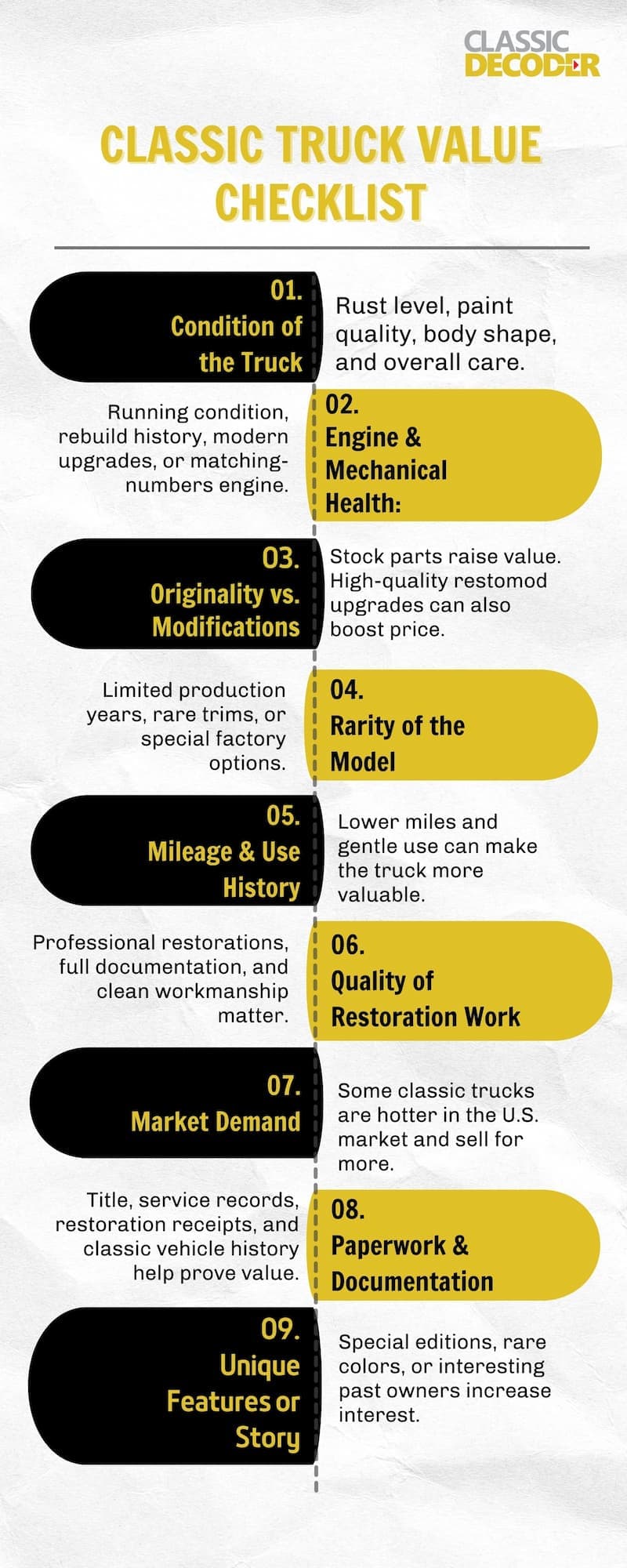
All classic trucks are not created equal. There are classic trucks that fetch thousands and some that fetch six figures. The value is determined by some important factors, such as:
Year and Model
Older and less common trucks tend to be more expensive. As an example, a 1955 Chevy 3100 or 1953 Ford F-100 may be more valuable than a 1980s car. Old trucks manufactured between the 1940s and 1970s have a high demand due to design and limited production.
Value can also be increased with limited-edition models or special trims or V8-powered trucks. Collectors are fond of originality and factory peculiarities.
Condition of the Truck
The condition of the vintage truck is one of the largest price determinants. A rust-free, clean and fully restored truck will always sell better. A beautiful paint job will not help a truck that has a faulty frame or parts. Severe collectors desire clean bodies, running engines, and the matching numbers.
Here are a few condition types to know:
- Barn Find: Old, untouched and long stored away, and may be valuable, when rare.
- Restored: Refurbished to original condition, including correct paint, parts and engine work.
- Restomod: Modernization such as improved engines or brakes, combined with vintage appearance.
Mileage
Mileage indicates the extent of usage of a truck. Less miles usually imply less wear and more value. Nevertheless, in the case of classic trucks, even a high-mileage car that is well restored can be sold at a good price. The point is the way it has been taken care of. A rebuilt or well maintained truck is as good as a truck with fewer miles.
Location
Your location can also have an impact on the values of classic trucks. Dry and sunny places such as California, Texas, or Arizona usually have less rust on their trucks, which makes them more attractive.
Conversely, vehicles used in regions with extreme weather conditions (winters) or salty roads may experience corrosion issues. Trucks that have clean solid frames, and original metal tend to attract high prices among buyers.
Demand
Popularity and trends are a major factor. When a model gets hot in the collector world the prices may soar. As an illustration, the Ford Broncos, Chevy Blazers, and Toyota Land Cruiser of the 1970s have experienced a significant increase in demand in the recent past. Even mid-condition trucks can fetch high prices when the demand is high.
Popular Classic Trucks You Can Buy Today
The classic trucks have emerged as one of the most rapidly expanding sections of the collector car market. The following are some of the most popular and useful models nowadays:
- F-100 Ford of the 1950s: Famous with its classic design and powerful V8. It is popular with collectors and very common in restorations.
- 1960s Chevy C10: The C10 is a stylish and smooth-riding truck that is currently among the best options available to classic truck lovers. It has a clean appearance and a robust construction, which make it ideal in restomods.
- Dodge Power Wagon: This truck is an off-road legend and a legend of the military as it was constructed to be tough and has a military history.
- Toyota Hilux of the 1970s: Small but tough. These vintage trucks are known to be reliable, and nowadays they are popular among collectors of vintage imports.
- GMC Sierra Classic of 1980s: The Sierra Classic was a representation of the transition of work trucks to lifestyle pickups as it was associated with comfort and striking appearance.
Best Way to Buy and Sell a Vintage Truck
The purchase or sale of a classic truck does not work the same as the modern cars. You require patience, research and honesty. The following are some of the professional hints that have been shown to assist in making an informed decision.
Classic Truck Buying Tips
You must always purchase through reputable websites, such as eBay Motors, Bring a Trailer, Hemmings, and ClassicCars.com. Here are some tips to guide you:
- 1.Do your research: Research the model, any issues, and the average prices.
- 2.Inspect before buying: Look at rust, leaks, or mismatched parts.
- 3.Test drive: Check if it runs and how it drives, shifts, and brakes.
- 4.Check paperwork: Make sure the classic truck VIN number, title, and engine numbers match.
- 5.Get the classic vehicle history report: The classic car VIN report will help in identifying any concealed issues such as theft, title problems, accidents, sales documents among others.
Classic Truck Selling Tips
It is better to be open and realistic with your price as this will help you find serious buyers and close deals more quickly. Here are the top-selling tips:
- 1.Know your classic truck value: Use appraisal tools or get a professional valuation before listing.
- 2.Clean and detail your truck: Good photos and presentation make your truck more attractive.
- 3.List on the right platform: Use online listings, classic car groups, or local shows.
- 4.Be honest in your ad: State all the upgrades, repair, or problems.
- 5.Prepare the documents: Buyers have trust in sellers who have all records and the history report.
Before listing your classic truck, take time to verify its value. A proper valuation can help you avoid underpricing it and losing money, or overpricing it and scaring away serious buyers. Start with a classic car VIN lookup to confirm the truck’s specifications, estimated market value, condition-related records, and vehicle history.
Obtaining the classic truck build sheet will also help in showing how the truck left the factory, including the details about the original engine, transmission, color and trim. Trucks that are in their original construction fetch higher prices to the collectors.
Comparing your truck with the ones in the same state, and using an online tool to estimate the antique truck value, will aid in determining a fair price to ask.
Most Commonly Asked Questions on Classic Truck Values.
Vintage-modern truck prices vary. Certain custom builds can sell at prices over $250,000, with simpler restored classics priced between $5000 and over $150,000, again depending on the model, condition and upgrades. As an example, a 1972 Ford F-250 with a modern V8 and fully restored might be sold for between $330,000, whereas small and entry-level projects can start at $15,000.
A truck is considered to be a classic when it is more than 40 years old and has not undergone any significant changes or improvements. However, this can vary. Other insurance companies consider vehicles as a classic when they reach the age of 15 years whereas the Antique Automobile Club of America identifies 25 years as the limit.

Content Writer
Adewale Peter is an automotive researcher and writer specializing in classic and pre-1981 VINs, historical vehicle identification, factory documentation, and classic-vehicle records. He writes about older VIN formats, archival research, Build Sheets, title and registration issues, and the limitations of modern decoding tools when applied to classic vehicles.